Modern service operations—especially at scale—need speed, consistency, and visibility across every customer interaction. While many AI providers promise this, this category has come with no shortage of hype, and not every solution delivers in practice.
In this post, we walk through why Rich Jordan of High Ground Service Pros chose Hatch after vetting the market. The journey is still underway, but we’re sharing the early learnings and results to help other operators navigate their own evaluation process.
The problem: Growth creates linear call center costs
High Ground Service Pros is a multi-state home services operator (HVAC, plumbing, and electrical) which, after scaling rapidly over the last five years, has ~150 employees across the Northeast.
Like many growing service businesses, they ran into a familiar ceiling:
- Costs: As call volume and locations expand, CSR headcount grows linearly, driving up SG&A and putting pressure on EBITDA.
- Service quality: At the same time, maintaining consistent service quality becomes harder as teams grow, training ramps, and SOPs multiply.
High Ground needed a way to keep responsiveness high and customer experience consistent without endlessly adding cost to the call center, so Rich began vetting AI solutions.

The problem with other AI solutions
As Rich evaluated voice AI, he ran into two recurring issues that showed up in day-to-day operations.
Disjointed systems
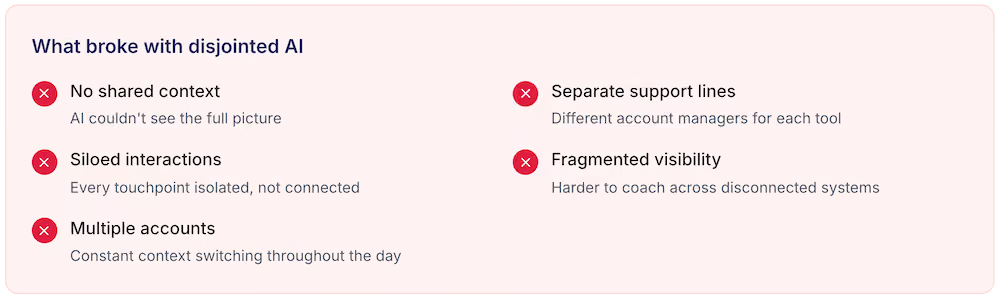
High Ground was already using Hatch for messaging AI (SMS and email), which consolidates all of your lead sources into one dashboard and allows fast, consistent messaging with customers. But they were using a separate platform for voice AI, which created problems. Juggling between two platforms meant that:
- Human CSRs had to work across two systems for their day-to-day and manage two separate vendor relationships.
- AI CSRs operated in silos, with no shared context across voice and messaging interactions
- Managers had limited visibility, with performance, conversations, and reporting split across multiple tools
AI voice provider limitations
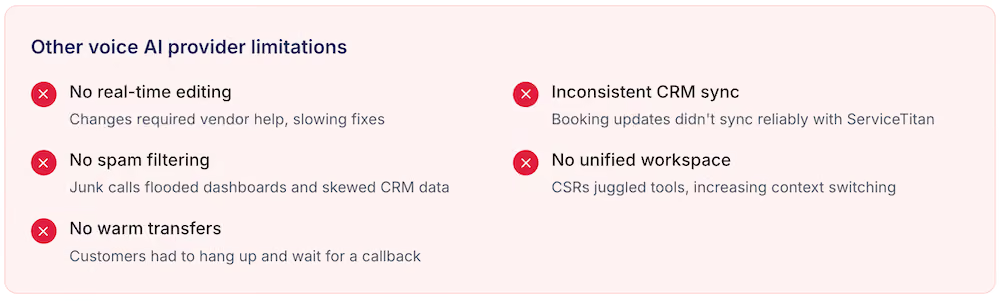
In addition, High Ground’s current voice AI provider came with limitations, including:
- Inability to edit AI behavior in real time: When changes require going through a vendor, fixes are slow—allowing small issues to impact dozens of customer conversations before they’re resolved.
- No spam call filtering: Spam and quick-hangup calls flood call queues and dashboards. Without filtering, teams waste time reviewing non-productive interactions and CRM data gets skewed and inactionable.
- No warm transfers: Without true warm transfers, customers who need a human have to hang up and wait for a callback. This creates friction at critical moments, particularly when customers are frustrated or need immediate help.
- Inconsistent booking sync with ServiceTitan: When booking and CRM updates aren’t tightly synced, trust breaks down—creating confusion for CSRs, downstream teams, and adding manual cleanup.
- No central portal where CSRs could work efficiently: CSRs juggle multiple channels, customer stages, and departments throughout the day. Without a single workspace—alongside the AI handling part of that load—context switching increases, efficiency drops, and consistency suffers.
The result was lost time, fragmented data, and missed opportunities, which created a drag on revenue performance, team efficiency, and customer experience.
Why High Ground chose Hatch
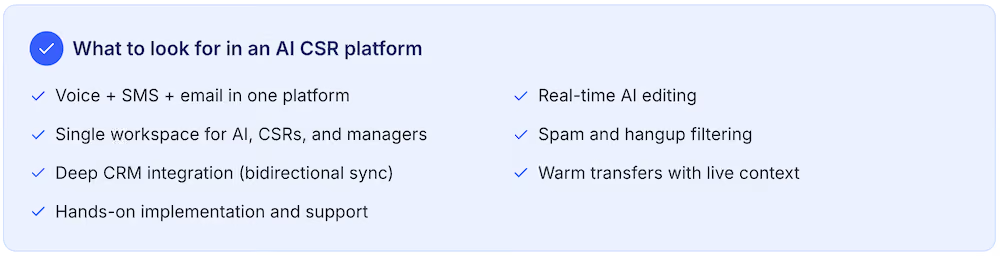
High Ground addressed these challenges by consolidating communication, intelligence, and operations into a single communications platform: Hatch. Here are the features that carried the most weight in that decision.
1. Unified communication
Both AI agents and humans communicate with customers over voice, SMS, and email from one platform. With all conversation history in one thread, anyone can jump in instantly with the right context—driving faster, more accurate responses and a seamless customer experience.
In addition, teams manage a single platform, account, and support relationship—instead of juggling multiple tools, logins, and vendors across channels
2. Comprehensive, editable knowledge base
Every AI CSR has a comprehensive knowledge base that allows you to customize three core aspects of your AI, including:
- Persona (personality, response speed, tone)
- Business knowledge (CRM, business profile, FAQ library, document and CSV uploads)
- Scripting (use your own or customize our best practice templates)
This ensures your AI and human agents share the same knowledge and deliver accurate, consistent answers and enables them to handle more complex, real-world conversations beyond basic FAQs.
Team members can also access and update the AI’s knowledge base any time—without relying on Hatch support—ensuring AI behavior stays accurate and current in real time.
3. A single operational layer for customer engagement
Hatch is not just another tool for CSRs to manage. Because it consolidates every customer conversation—across channels and every stage of the journey—into one unified workspace, Hatch becomes the operating headquarters where AI CSRs, human CSRs, and managers work together.
- AI CSRs handle customer conversations and administrative work automatically
- Human CSRs monitor AI conversations, review transcripts and recordings, refine AI behavior, manage escalations, and complete admin tasks
- Managers review conversations, coach performance, and track outcomes and ROI
The result is a single, efficient operating layer where AI and humans work side by side, with full visibility, accountability, and continuous improvement built in.
4. Smarter spam filtering
Hatch automatically filters spam and quick-hangup calls, which does two things:
- Protects CSR time: CSRs don't have to wade through a sea of low-value conversation cards or transcripts.
- Keeps data clean: Filter spam out of the system keeps ServiceTitan data clean and accurate.
5. Warm transfers
When a customer needs to speak with a human, the Hatch Voice AI transfers them on the same call, briefing the human agent with a live summary before they join. This gives the human full context, eliminates repetition for the customer, and creates a smoother experience overall.
6. Deep ServiceTitan integration
Hatch syncs data bidirectionally, ensuring every customer interaction is logged, tracked, and visible across teams and preserving the CRM as the source of truth. In addition, the AI CSR can:
- Refer to CRM data so the customer doesn’t have to repeat themselves
- Disposition conversations that sync back to ServiceTitan
- Reliably book appointments on the ServiceTitan calendar
7. Implementation and support
Hatch pairs its platform with a hands-on AI implementation and support team that works as a true partner—starting with how your business already operates and building AI to support it. This includes:
- Deep technical discovery and setup
- Custom solutions when needed
- Ongoing refinement
The result is an AI-first capability that still operates your way—scaling what already works while improving speed, consistency, and customer experience.
Early results
Within the first few months of rolling Hatch Voice AI into frontline call handling, High Ground saw measurable improvements across operations, efficiency, and customer responsiveness:
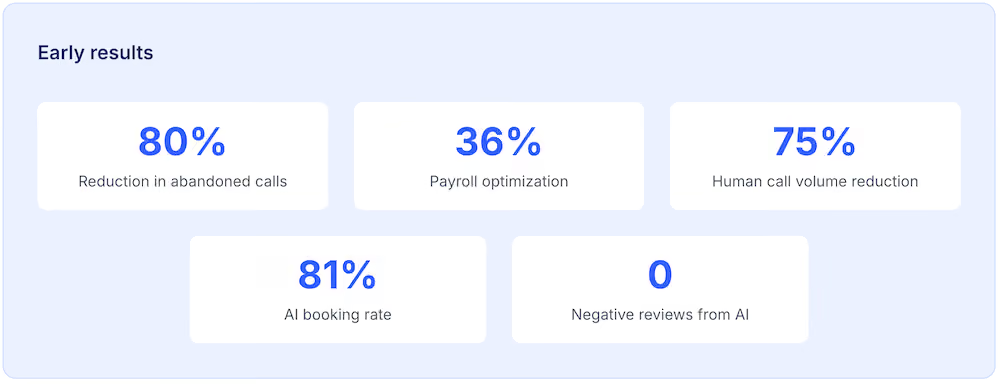
- Abandoned call rate: Dropped from ~10% to ~2% (80% drop)
- Operational efficiency: 36% reduction in CSR headcount, while retaining and upskilling top performers into higher-value roles.
- Human workload: 75% reduction in call volume handled by human CSRs,allowing the team to focus on escalations and complex work
- Booking performance: AI is booking ~81% of bookable leads—on par with a strong human call center (Industry benchmark is 60%)
- Call efficiency: Average call duration remained steady at ~3–3.5 minutes, indicating efficient, natural conversations without friction
- Customer experience: No increase in negative customer feedback, including zero one-star reviews attributed to AI interactions
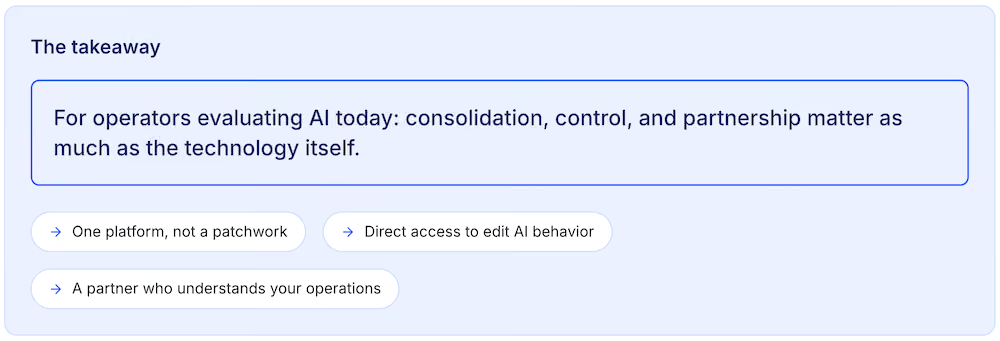
High Ground’s journey with AI is still evolving, but the early results show what’s possible when AI is implemented as an operating layer—not a point solution. For operators evaluating AI today, the lesson is clear: consolidation, control, and partnership matter as much as the technology itself.