Hatch Updates & Info
Introducing Hatch Outbound Voice AI
Turn outbound calling from a manual bottleneck into a scalable, AI-powered workflow.
A recap of our live Outbound Voice AI walkthrough — how it works and how it helps you scale outbound calls more efficiently.
Outbound calling is one of the most important workflows in service businesses. But confirmations, follow-up, and re-engagement are hard to scale without adding cost, headcount, and operational drag.
That’s why we launched Outbound Voice AI.
In this webinar, Hatch AI experts Kristen McCormick, Charlie Lasswell, Chris Wren, and Steven Knollmeyer walked through how Hatch’s new outbound Voice AI works, where it fits in the customer journey, and how it works alongside AI-powered SMS, email, and inbound call handling.
We also covered some ServiceTitan calendar booking updates. Read on for the skim-friendly recap.
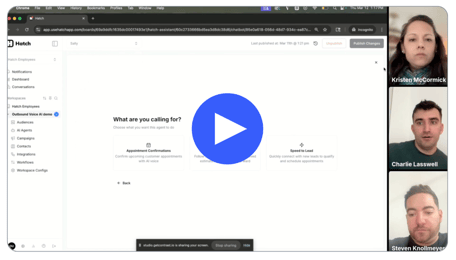
Here’s what the team walked through in the live demo.
Until now, Hatch AI has worked across two areas: Voice AI for answering inbound calls, and Messaging AI for powering trigger-based outbound campaigns across SMS and email (where you could add a manual call step). Outbound Voice AI completes the picture — now every channel and every direction is AI-powered in one system. Read the full launch announcement here.
Outbound Voice AI is now another step inside a campaign, which means teams can build sequences like:
With Outbound Voice AI now sitting alongside inbound Voice AI, SMS, and email in the same system — customer communication is now even easier to scale across the entire journey.
The flow is simple:
In the demo, Charlie walked through an appointment confirmation flow.
If the customer answers, the AI can:
If the customer doesn’t answer, the AI can:
Because it lives inside campaigns, Outbound Voice AI works alongside the same automation Hatch users already rely on.
The webinar emphasized that Outbound Voice AI works best for operational conversations when a customer already expects communication from your business—as opposed to cold outreach, marketing blasts, or calling aged lead lists.
Examples shared included:
That’s not to say you can’t use any promotional language or ask qualifying questions—it’s just that outbound Voice AI is most effective (and most compliant) when there’s an existing relationship. Operational use cases tend to have the highest answer rates and the best customer experience.
Outbound calls tend to be simpler than inbound ones. That’s because inbound Voice AI must be ready to handle dozens of scenarios — new leads, rescheduling, billing questions, vendor calls, and more.
Outbound Voice AI agents, on the other hand, can have one clear goal, like confirming an appointment or following up on a quote.
That makes it easier for the AI to stay focused and guide the conversation. The AI can also personalize calls using CRM data like:
That context makes the conversation feel relevant rather than generic.
Rather than placing a call multiple times a day, Outbound Voice AI works best when paired with other channels. For example:
That text might say:
“Hey [First Name], we tried calling about your appointment. If it’s easier, feel free to reply here or book online.”
Some customers prefer phone, others prefer text. Campaign automation lets you reach both.
AI handles the routine conversations. Humans handle the complex ones.
If a customer wants to speak to a person, asks a complex question, or needs to reschedule, the AI can transfer the call to a human representative.
Before transferring, the system provides a summary of the conversation, so the representative has context when they answer.
The webinar also introduced updates to Hatch’s ServiceTitan calendar integration. This included a mix of new and existing features with an enhanced UI that groups them together into one easier-to-manage panel.
Businesses now have more granular control over what the AI can do inside ServiceTitan.
New options include:
For example, customers can leave details like:
Those notes are automatically added to the job.
The Hatch team also showed more advanced booking logic, including:
The webinar included dozens of audience questions. Here are some of the most common ones.
What happens if someone answers but doesn’t say anything?
The AI repeats the greeting once or twice. If there’s still no response, the call ends automatically.
Can the AI call multiple times if someone doesn’t answer?
Yes. Campaigns can include multiple call attempts or follow-up steps. However, Hatch recommends spacing attempts out rather than calling repeatedly in a short window.
Can the AI send a text if the call isn’t answered?
Yes. Many customers pair outbound calls with SMS and email follow-up.
Can the AI transfer to a human?
Yes. If a customer asks for a human or a more complex issue comes up, the call can be transferred to your team.
Do customers know they’re speaking to AI?
Yes. For outbound automated calls, regulations require the caller to disclose that it is an automated assistant. That disclosure is included in the greeting message.
How does Hatch avoid calls showing up as spam?
Hatch takes several steps to improve call reputation, including:
Following best practices with call cadence and use cases also helps maintain strong deliverability.
Can teams test the AI before launching?
Yes. Hatch includes an AI playground where teams can test conversations and refine prompts before going live.
Can the AI follow a specific sales style?
Yes. Prompts can define tone, conversation style, and how the AI handles objections.
Can the AI reference information from SMS conversations?
In many cases yes, especially when information is stored in the CRM or contact record.
If you’re a Hatch customer, reach out to your Account Manager here.
If you’re not a Hatch customer, you can learn more or book a demo here.
Turn outbound calling from a manual bottleneck into a scalable, AI-powered workflow.
Get the insights from our webinar with John Wilson on optimizing contact centers for efficiency, growth, and customer satisfaction, including AI...
Learn how to maximize your Google LSA success — and how to navigate the new 'request competitive quotes' feature.