Hatch and Siro teamed up for a product walkthrough of their integration — showing how in-home conversation data flows into AI-powered estimate follow-up at scale. Even if you don't use the integration, the best practices covered here apply to any estimate follow-up motion.
Read on for the skim-friendly recap.
👉 Watch the webinar recording here
✅ TLDR: 5 top takeaways
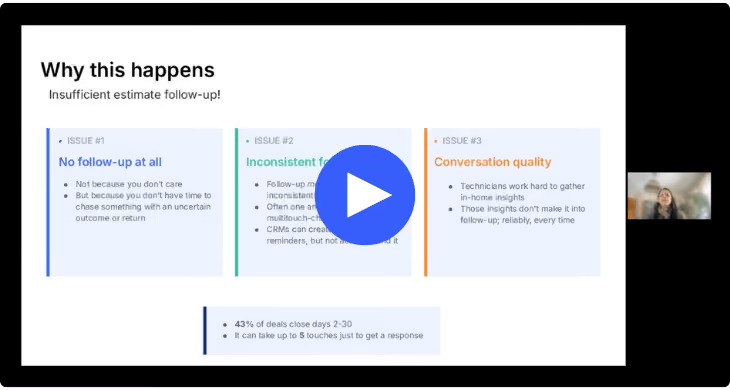
- 80% of estimates don't close in the home — and 43% close between days 2 and 30. That's revenue most teams leave on the table.
- Follow-up doesn't need to be personalized to get the response. General, feedback-oriented outreach ("How did your visit go?") works best for the initial reach-out. Personalization matters when they reply.
- Siro scores every lost deal 1–5 and only passes the hottest leads (3+) to Hatch — so you're not chasing everything, just the right things.
- The AI agent uses in-home context to engage. Emotional ties, objections, financing details, and commitment level from the Siro recording all feed into the Hatch AI's responses.
- One company influenced $2M in revenue in 100 days with this integration running automated rehash — 77 influenced sales at a 56% response rate.
Full recap
🎙️ The speakers
- Kristen McCormick: Head of Marketing, Hatch
Hatch is an AI CSR platform that scales revenue-driving conversations across SMS, email, and voice — with AI agents that work alongside humans to convert more efficiently. - Caelahn Bullen: Director of Partnerships, Siro
Siro is a conversation intelligence platform that captures, transcribes, and analyzes in-home sales conversations — surfacing missed opportunities and arming teams with insights to close more deals.
🧠 The problem: lost demo-no-sale revenue
Kristen broke the problem into three buckets:
- No follow-up at all. Not because nobody cares — reps have more estimates to run and it's a gamble whether chasing unsold estimates is worth the time.
- Inconsistent follow-up. Maybe one or two reps do it, but it's not standardized. Or it's one channel, one touch, and done — when it can take 5–8 touches just to get a response.
- In-home insights don't carry forward. The person doing the follow-up often isn't the one who ran the appointment. And even when it is, recalling the details isn't easy.
"For a lot of companies, it's untapped potential. You go into the home, you run a great appointment, and then 43% of those deals close on days 2 through 30." — Kristen
🔍 How Siro surfaces the right leads to follow up on
Caelahn walked through how Siro prioritizes which lost deals are worth going after:
- Automatic scoring: Within 5–10 minutes of a lost deal, Siro scores the opportunity 1–5 based on the in-home conversation. Only leads scoring 3+ get passed to Hatch.
- Structured data from the conversation: For each lost deal, Siro extracts:
- First and final price quoted
- Financing details discussed
- Customer's commitment level
- Main objection
- Emotional tie — what's actually driving the customer to buy
- Revenue visibility: Siro surfaces your total rehash revenue potential so you can see what's on the table.
"We had 3,120 opportunities totaling about $45 million. As soon as you start recording, Siro surfaces all of those missed opportunities with recaps and recommended next steps." — Caelahn
📩 How Hatch automates the outreach
The bridge between Siro and Hatch is the CRM. Siro writes structured data to the contact record, and Hatch uses that to power campaigns and AI agents.
The outreach itself is general — and that's intentional.
Hatch's best-practice estimate follow-up templates use feedback-oriented messaging that works across verticals and job types:
- "My job is to follow up and make sure you had a great experience. Text me back with any questions or feedback."
- "I was looking at your quote and wanted to see if you had come to a decision. Do you have any questions?"
- "Wanted to follow up on your estimate. Are you still considering moving forward, or has anything changed?"
These messages serve two purposes: get a response and surface objections.
Key details on the campaign setup:
- Multi-channel (SMS + email + ringless voicemail), multi-day sequences
- Campaign keeps firing until the customer responds
- Audiences are built from CRM data so contacts auto-enroll when they meet criteria (e.g., open estimate for 7+ days, specific job type, business unit)
- Fully customizable per job type, location, or sale type
"You are not having to do the chasing. Hatch is doing the chasing for you, which is a really big pain point for a lot of teams." — Kristen
🤖 Where the Siro data kicks in: the AI conversation
Once a customer responds to the outreach campaign, the Hatch AI agent takes over — and this is where Siro data makes the conversation personal.
Without Siro, the AI agent can still:
- Answer FAQs from its knowledge base
- Qualify leads
- Book appointments (including directly in ServiceTitan)
- Escalate to a human when needed
With Siro, the AI agent also knows:
- The customer's emotional tie (why they actually want this)
- Their main objection
- Financing details discussed
- Their commitment level from the conversation
Real example from Caelahn: "A rep went into a window job. They didn't log anything about the customer losing sleep because bugs were crawling through the window. But Siro captured it, and the follow-up said, 'I know you're losing sleep — is this still an issue? We'd love to help.' That detail would have gone missing without it."
More examples of Siro-powered AI responses:
- Instead of "When would you like to move forward?" → references the customer's timeline from the conversation
- Instead of generic product talk → mentions the specific product discussed in the home
- Instead of "Are any budgetary concerns holding you back?" → references a real concern like college tuition that came up
📊 Results: $2M influenced revenue in 100 days
Caelahn shared a case study from a customer running the integration:
- Response rate: 56%
- Influenced sales: 77
- Influenced revenue: $2M
- Time period: 100 days
Important context on attribution: These are influenced results, not direct attribution. If a deal closed and a Hatch campaign using Siro data was involved, it counts as influenced. Hatch is also building configurable attribution windows (30, 60, 90 days) for future releases.
"This company was already doing rehash. But they didn't have to touch anything once this was set up. This was automated rehash — and the stats speak for themselves." — Caelahn
On response rate benchmarks (Kristen):
- Speed to lead campaigns: 60–65% average, 70–80% with best practices
- Estimate follow-up campaigns: typically lower — so 56% is a strong result
- AI agent first-reply time: under 5 seconds vs. up to 15 minutes for humans juggling conversations
💬 Q&A
Q: Can you customize the outreach sequence per job type?
A (Kristen): Yes. You can customize campaigns by job type, business unit, location, or any other criteria in your CRM. Your audience rules determine who enrolls into which campaign.
Q: How does the AI agent know about things like rebates or promotions?
A (Kristen): You can upload documents, add FAQs, or fill in structured fields in the AI agent's knowledge base. If it's a time-sensitive offer, you add it and then remove it when it's over.
Q: Do you prompt the AI with your own responses?
A (Kristen): It's generative conversational AI. You give it knowledge and instructions about how to behave, and it generates replies. You test it before launch, monitor it live, and make adjustments — it only needs to be told once.
Q: What happens when the AI can't answer a question?
A (Kristen): You set the guardrails. You can create transfer rules so the AI escalates to a human when it hits a limit — like pricing questions or anything you don't want it handling. For estimate follow-up conversations, the threshold for escalation is typically lower.
Q: Can you tone back the instant response from the AI?
A (Kristen): Yes. There's a slider to adjust response time so it doesn't feel robotic.
Q: Does Siro sync with improveit 360?
A (Caelahn): Yes. And Hatch integrates with i360 as well.
Q: Can you use Hatch and Siro without a CRM?
A (Kristen): No. Hatch needs CRM data to build audiences and know who to target. You can use Hatch for rehash without Siro, but you can't use Hatch and Siro together without a CRM.
Q: What is rehash?
A (Caelahn): Rehash means going after leads that a rep engaged with but didn't close — re-engaging them to get a second chance at closing the deal.
Q: Does this integration with Rilla?
A (Kristen): Hatch only integrates with Siro for in-home conversation data at this time.
Q: Is there an additional charge for the integration?
A (Caelahn): No additional fee to set up the integration. Since Hatch is usage-based, more conversations may affect usage, but the integration itself is included.
Additional resources
💡 For more about the integration, head to our blog post.
👀 To get a closer look, download the Hatch <> Siro Integration Lookbook here.
✅ To get started, book a demo here.
For past and upcoming Hatch webinars, check out our webinar page!