
Your office closes at 5 PM, but the phone doesn't stop ringing. A homeowner with a leaking water heater calls at 7:30 PM. A roofing lead from Google Local Services Ads hits at 10 PM after they've spent the evening researching contractors. An HVAC prospect calls during your busiest Saturday because that's when they finally had time to think about replacing their system.
The question isn't whether you need help handling customer calls. It's which kind of help actually fits how your business works. Traditional answering services, call centers, and AI customer service platforms all promise to solve the missed-call problem, but they serve different needs, carry different costs, and deliver different outcomes for the customers trying to reach you.
This guide breaks down what each option actually does, what it costs when you account for the full picture, and how to match your choice to your call volume, service mix, and growth goals.
Key takeaways
- Each option serves a different operational need: Answering services handle low-to-medium volume with personalized attention; call centers manage high-volume transactional operations; AI platforms provide 24/7 coverage with direct appointment booking and varied pricing models.
- Missed calls cost more than most contractors realize: Home service companies miss a significant portion of their calls. 41% go unanswered by a person, while another study found the number reaches 74.1%. The average contractor loses an estimated $260,400 annually in revenue from opportunities that never get a response.
- Full costs go beyond monthly invoices: Turnover, escalation costs, and customer churn risk change the math significantly when comparing in-house staff to outsourced options.
- Automated estimate follow-up helps keep quoted jobs moving when homeowners don't make an immediate decision.
- The right choice depends on your call mix: Emergency-heavy trades need instant response and human escalation paths; estimate-driven businesses benefit from systematic follow-up; high-volume operations need scalable coverage without per-call pricing.
An AI communications platform can connect call answering, appointment booking, and customer follow-up rather than treating each interaction separately.
What traditional answering services actually do
A traditional answering service provides live human operators who answer calls on your behalf. When a customer calls your business line after hours or during overflow periods, the call routes to the answering service. An operator answers using your business name, takes a message, and forwards that message to you via text, email, or an online portal.
The core value is simple: a person answers instead of a machine. The operator can ask basic questions, note the caller's issue, and capture contact information. Answering services vary in their scheduling capabilities. Basic plans may focus on message-taking and forwarding appointment requests, while more advanced services can book appointments directly into connected calendars, qualify leads, and route urgent calls to the appropriate team member.
How answering service pricing works
Most answering services charge per minute of talk time or per call. Rates typically range from $403 to $1,160 per month for around 100 calls, depending on the provider and service level. This pricing model means your costs rise during busy periods, which is exactly when you most need the coverage.
A roofing company after a major storm or an HVAC company during a heat wave might see call volume spike 5-10x. Under per-minute pricing, that surge translates directly into a larger bill, often arriving after the busy period when cash flow has already absorbed the operational strain.
When answering services make sense
Answering services work well for businesses with relatively low call volume, straightforward service requests, and the capacity to follow up quickly. If you're a small plumbing company handling 30-50 calls per month and you can return messages within an hour or two, an answering service might be enough.
The limitation is what happens after the message gets taken. The answering service captures the lead, but converting that lead into a booked job still depends on your team calling back, qualifying the opportunity, and getting the appointment scheduled. Every hour between the customer's initial call and your return call increases the chance they've already booked with a competitor.
How call centers differ from answering services
Call centers are built for scale. Where answering services handle dozens to hundreds of calls per month with conversational flexibility, call centers are designed to process thousands of calls daily using scripted interactions and specialized software.
The typical call center interaction is more structured. Agents follow scripts, work through qualification questions in a defined sequence, and handle calls that often run 10-15 minutes rather than the 1-2 minute message-taking common with answering services. Call centers also typically offer outbound calling for appointment confirmations, estimate follow-ups, and customer surveys.
The enterprise trade-off
Call centers make economic sense for large multi-location operations or franchise groups handling enough volume to justify dedicated agent teams. The trade-off is personalization. A call center agent handling calls for dozens of different businesses won't have the same familiarity with your specific services, pricing, or service area as a dedicated team member.
For most single-location or small multi-location home service companies, call center services are overkill. The infrastructure is designed for enterprise scale, and the pricing reflects that. If you're running an HVAC company with 3-5 technicians, you don't need a call center. You need consistent coverage that can actually book appointments.
What AI platforms bring to the table
AI platforms use artificial intelligence to handle customer conversations across voice, text, email, and web channels. Unlike answering services that take messages, AI can qualify leads, answer common questions, and book appointments directly into your scheduling system.
The practical difference shows up in what happens after the customer makes contact. When a lead calls an answering service at 9 PM, they leave a message and wait for a callback. When that same lead reaches an AI platform connected to your scheduling system, the AI can confirm you serve their zip code, ask about their issue, check your calendar availability, and book an appointment before the conversation ends.
This matters because nearly 80% of leads buy from the first company that responds. An AI platform that books the appointment in the same conversation eliminates the gap between initial contact and scheduled job.
The 24/7 coverage advantage
AI platforms can provide 24/7 coverage without requiring businesses to staff additional shifts. Pricing varies by provider, with some offering flat monthly plans and others charging based on calls, minutes, or usage allowances. Businesses should compare included call volumes, overage fees, and simultaneous call capacity before choosing a platform.
About 28.5% of calls arrive outside business hours, and these after-hours callers are often the highest-intent customers, particularly for emergency services.
A homeowner calling about a burst pipe at 2 AM isn't shopping. They're booking with whoever answers. Under traditional coverage models, capturing that emergency call requires either on-call staff (leading to burnout and inconsistent quality) or premium-priced after-hours answering service coverage. An AI platform handles that call the same way it handles a Tuesday afternoon inquiry.
What AI can and can't do
AI excels at routine, predictable interactions: qualifying new leads, booking standard appointments, confirming upcoming visits, and answering common questions about services, pricing, and availability. It can handle multiple conversations simultaneously, never call in sick, and maintain consistent quality whether it's the first call of the day or the hundredth.
Where AI needs human backup is in complex or emotionally charged situations. A customer disputing an invoice, a homeowner describing an unusual problem the AI hasn't been trained on, or someone in genuine distress during an emergency all benefit from human involvement. The best implementations recognize this and include clear escalation paths rather than forcing every interaction through the AI.
{{in-line-cta}}
Comparing the true cost of each option
The monthly invoice only tells part of the story. To understand what each option actually costs, you need to account for turnover, training, escalation, and the revenue impact of missed or mishandled opportunities.
In-house staff costs
Hiring a dedicated customer service representative costs 42,000- 52,000 annually when you include salary and benefits. But that only buys you 40 hours of coverage per week. Evenings, weekends, and holidays require either overtime, additional staff, or an alternative solution.
The hidden cost is turnover. Call center and customer service roles see 30-45% annual attrition, with some estimates reaching 70% in high-stress environments. Each replacement costs 22,500-33,750 when you factor in recruiting, hiring, and training. A two-person team with 40% turnover means you're effectively hiring and training a new person every year.
Answering service costs
At 403-1,160 per month for 100 calls, answering services look affordable until you hit busy season. A severe weather event that drives 300 calls in a week could triple your monthly bill. Per-minute overages add up quickly when customers need to explain their situation in detail.
There's also an indirect cost in conversion. The answering service takes the message, but the lead isn't booked until your team follows up. Every lead that goes cold before you return the call represents lost revenue that doesn't show up on the answering service invoice but absolutely affects your bottom line.
AI platform costs
AI platforms typically charge flat monthly rates ranging from $199 to $2,000+ depending on features, channels, and call volume. Some providers charge per call with monthly allowances and overage fees. The key is understanding what's included in your plan and how costs scale as your business grows.
The return on investment calculation comes down to how many additional jobs you book from leads that would otherwise go to voicemail or wait too long for a callback. If the AI books even 2-3 additional jobs per month that you would have missed, the platform often pays for itself.
What implementation patterns work
Customer acceptance of AI depends heavily on how you implement it. When AI handles after-hours appointment booking and humans honor those appointments the next day, customers get coverage when they need it without sacrificing service quality. The appointment happens as scheduled, and the AI stays out of situations where human judgment matters.
What drives negative reactions
Problems typically arise from predictable implementation failures:
- AI-booked appointments that didn't happen: The AI scheduled a time, but the company either couldn't keep the appointment or never showed. This isn't an AI problem. It's a systems integration problem where the AI isn't connected to actual calendar availability.
- AI blocking access to humans during emergencies: Customers with burst pipes or no heat need to reach someone who can dispatch help immediately. When AI becomes a barrier rather than a pathway to assistance, the frustration is understandable.
- AI pretending to be human: Some platforms give their AI human names and personas. Customers feel deceived when they realize they've been talking to a machine that was designed to seem like a person.
The implementation lesson
Customers accept AI when it extends your availability without replacing human relationships. Use AI for after-hours coverage, routine scheduling, and appointment confirmations. Ensure genuine emergencies can reach a human. Don't try to hide the fact that AI is handling the conversation.
Homeowners increasingly expect 24/7 scheduling and communication options. They're not opposed to technology. They're opposed to technology that wastes their time or prevents them from getting help when they need it.
Beyond call answering: the customer journey question
Here's where the comparison gets more interesting. Traditional answering services and basic AI receptionists solve one problem: making sure someone (or something) answers the phone. But the customer conversation doesn't end when the call is answered.
Think about what happens after a lead calls your roofing company. Someone answers. They capture the information. Then what?
- Does the lead get a confirmation text with the appointment details?
- If the appointment is three days out, does someone remind them the day before?
- If they got an estimate but didn't book, does anyone follow up?
- If they booked six months ago, does anyone reach out when it's time for maintenance?
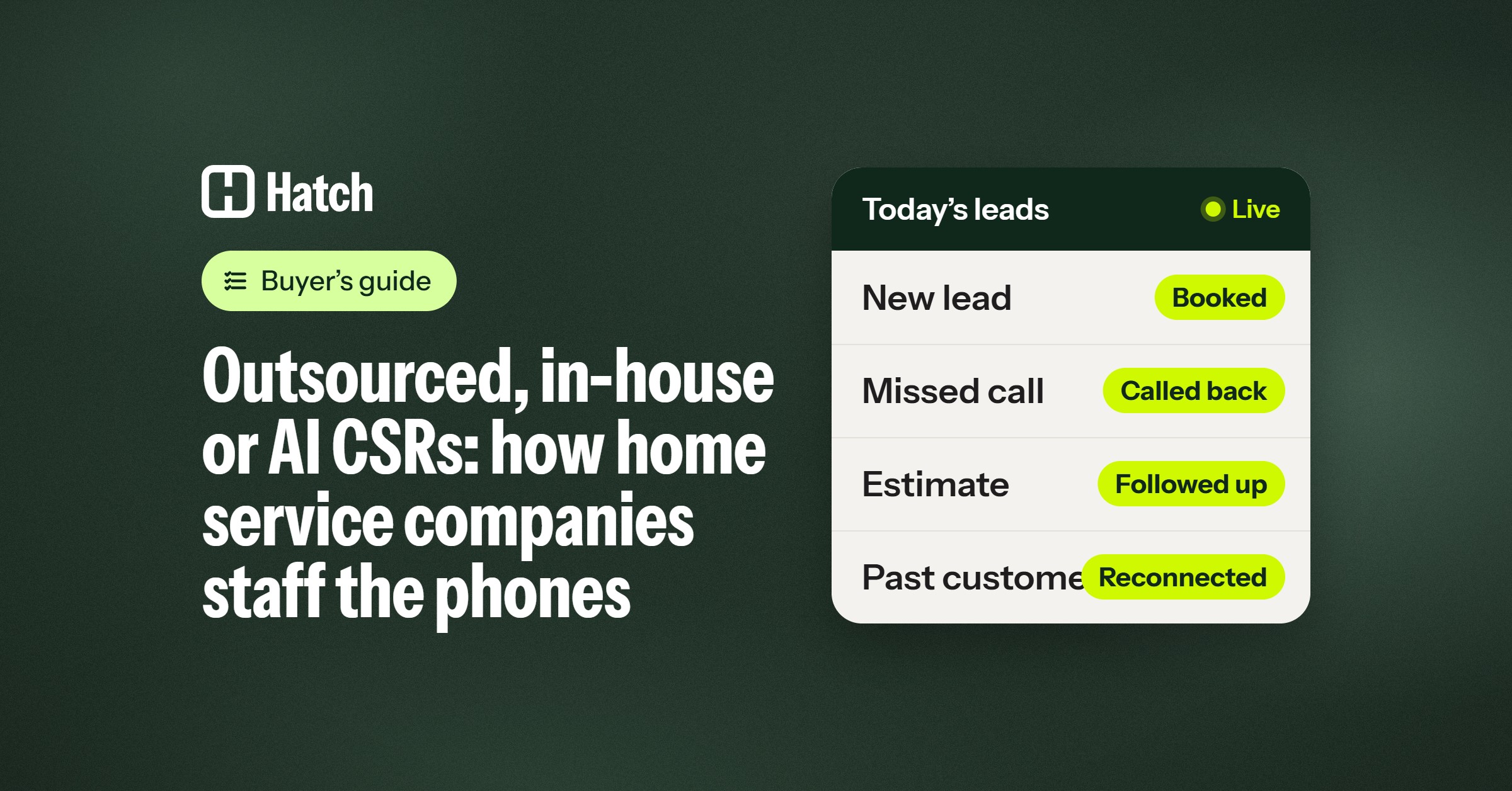
Answering services stop at message-taking. Many AI receptionist tools stop at call handling. The full customer journey involves lead response, qualification, booking, confirmation, follow-up, nurture, reactivation, and ongoing customer care.
Why gaps in coverage create problems
A business that uses a basic AI receptionist for inbound calls still needs a separate process for estimate follow-up. They need another tool or manual process for appointment reminders. Reactivating past customers requires yet another approach.
Each gap in the process represents potential lost revenue. Consumers increasingly expect seamless service experiences. The experience isn't just how you answer the phone. It's whether you confirm the appointment, whether you follow up when they don't immediately say yes, and whether you stay in touch after the job is done.
How a full communications platform differs from a basic receptionist
This is where the distinction between single-purpose tools and complete platforms matters. An AI receptionist answers calls. An AI communications platform manages customer conversations across the entire relationship.
Hatch, for example, was built specifically for service businesses. Its AI doesn't just answer and qualify calls. It works across voice, text, email, and web to:
- Respond to new leads from sources like Yelp, Angi, Google Local Services Ads, and Thumbtack
- Book appointments directly using the business's scheduling rules and calendar availability
- Confirm upcoming appointments to reduce no-shows
- Follow up on estimates that haven't converted
- Nurture leads that aren't ready to book immediately
- Reconnect with past customers when it's time for maintenance or repeat service
The platform connects to scheduling systems like ServiceTitan, LeadPerfection, improveit 360, and AccuLynx through its Data Bridge, so the AI has access to real calendar availability and customer history rather than operating in isolation.
When conversations need human attention
Hatch's approach doesn't try to remove humans from the process. When a conversation requires judgment, expertise, or personal attention, the platform's Command Center makes it easy for team members to take over. The AI handles the routine interactions that would otherwise consume staff time, freeing the team to focus on the conversations that benefit most from human involvement.
This is different from positioning AI as a replacement for staff. The goal is giving your existing team more capacity and more consistent coverage, not making employees obsolete.
Matching your choice to your business
The right answer depends on your specific situation: your call volume, your service mix, your current coverage gaps, and your growth plans.
Choose an answering service if:
- You handle fewer than 100 calls per month
- Your calls are primarily message-taking rather than appointment booking
- You have the capacity to follow up on messages within 1-2 hours during business hours
- You're comfortable with variable monthly costs that rise during busy periods
- Personal touch matters more than booking speed for your customer base
Choose a call center if:
- You're a large multi-location operation or franchise group
- You handle thousands of calls monthly across multiple brands or service lines
- You need dedicated agent teams with deep training on your specific services
- Your call handling requires complex scripts and extensive qualification processes
- You have the budget and scale to justify enterprise-level infrastructure
Choose an AI platform if:
- You need 24/7 coverage without staffing multiple shifts
- Call volume fluctuates seasonally and predictable costs matter
- You want leads booked during the initial conversation rather than waiting for callbacks
- Your scheduling system can integrate with the platform
- You need help with more than just answering calls, including follow-up, confirmation, and reactivation
Consider a hybrid approach if:
- You have complex emergency protocols requiring immediate human dispatch
- Your customer base includes demographics with lower AI acceptance
- You want AI handling routine calls while humans manage relationship-sensitive interactions
- You're transitioning from an existing solution and want to test AI before full adoption
Why home service businesses choose Hatch
Most home service companies don't just need someone to answer the phone. They need a system that captures leads, books appointments, follows up consistently, and stays connected with customers over time.
Hatch was built specifically to solve this broader challenge. Unlike basic answering services or standalone AI receptionists, Hatch provides a complete communications platform that handles every customer interaction from the first inquiry through repeat business.
The platform connects directly to your existing scheduling system, so AI can book appointments into real available slots instead of just taking messages. When leads come in from Google, Yelp, Angi, or any other source, Hatch responds immediately and works to convert that lead while they're still engaged. For estimates that don't convert right away, the system follows up systematically instead of letting opportunities go cold.
For home service businesses handling 50-500 calls per month with seasonal fluctuations, this approach delivers better results than either answering services that just take messages or basic AI tools that only handle inbound calls. The platform grows with your business, connecting every customer touchpoint into one system that actually helps you book more jobs.
Making the decision
The missed-call problem costs the average contractor over a quarter million dollars annually. Solving it requires more than just answering more calls. It requires converting those calls into booked jobs and those jobs into lasting customer relationships.
Traditional answering services and call centers solve the immediate problem of making sure someone answers. AI platforms go further, handling qualification, booking, and follow-up without requiring your team to manually manage every interaction.
The question isn't whether AI is better than humans. It's which combination of coverage, cost, and capability fits your operation. For most home service companies running 50-500 calls per month with seasonal fluctuations and after-hours demand, an AI platform offers the best balance of consistent coverage, predictable pricing, and direct booking capability.
Start by mapping your current coverage gaps. Where are you missing calls? What happens to leads after the initial contact? How consistently do you follow up on estimates? The answers point toward the solution that will actually move the needle on booked jobs.