For home service businesses, every missed call or delayed response can mean lost work. And keeping up with new inquiries, appointment confirmations, estimate follow-ups, and past customers gets harder as your business grows.
A homeowner calls about an urgent repair while your team is already handling other customers. Nobody picks up, so they call the next contractor. By the time someone on your team follows up, the job may already be booked elsewhere.
AI communications platforms help contractors stay responsive across calls, texts, emails, and web inquiries without adding more work for their teams. This guide looks at how these tools work, what to consider when evaluating them, and how they can help turn more customer conversations into booked jobs.
Key takeaways
- There is no single best AI answering service for every roofing contractor. Smaller businesses may prioritize simple setup, while larger teams may need deeper integrations and more extensive call handling.
- Roofing-focused services address industry-specific needs. Features worth evaluating include storm-damage intake, emergency routing, insurance information capture, and inspection booking.
- Hybrid services offer another approach. Combining AI with human receptionists can help when calls involve complicated questions or sensitive customer situations.
- Call volume and billing structure affect long-term fit. Review usage limits and how charges change during storm season before committing.
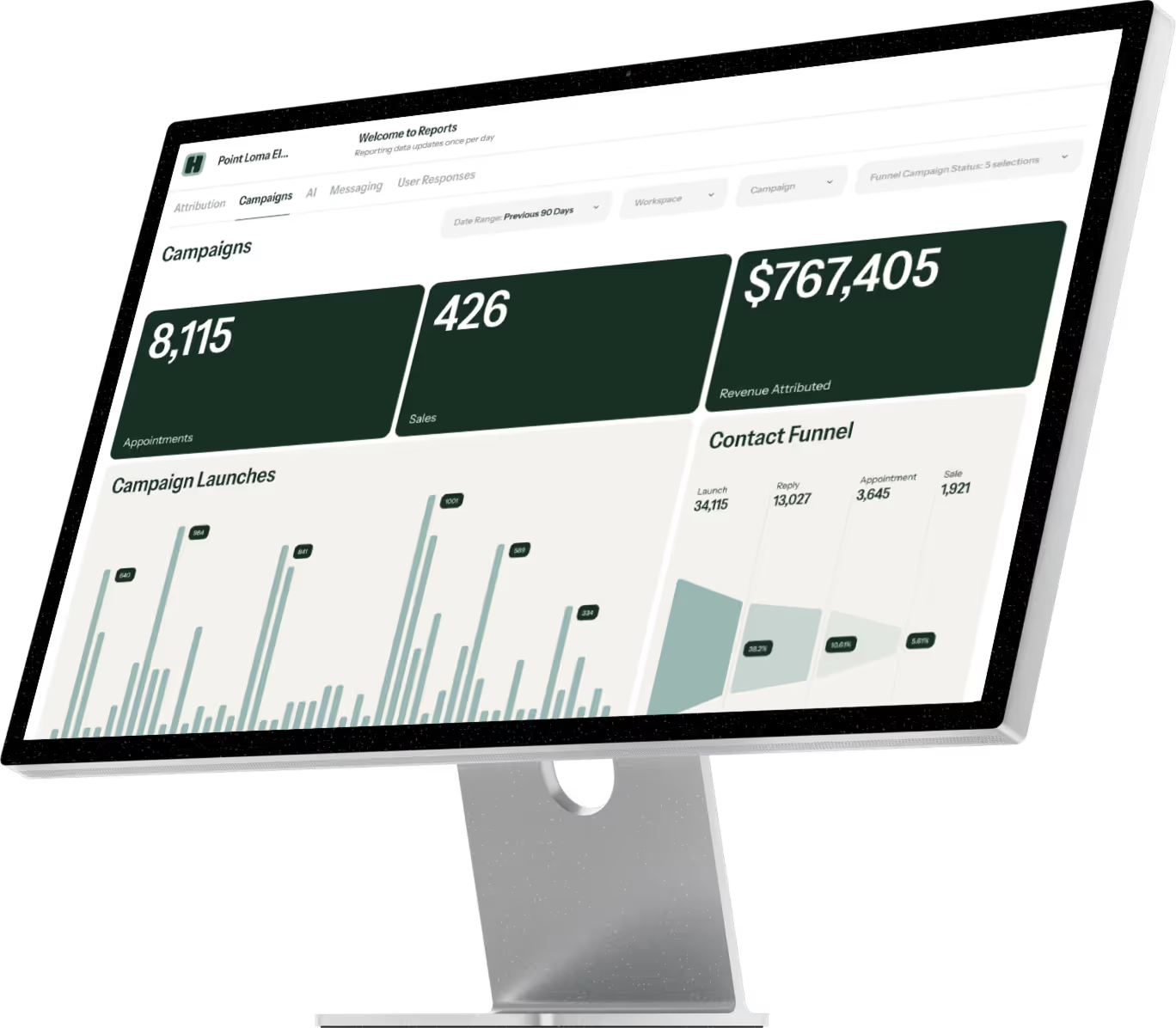
- Broader communications platforms cover more than incoming calls. Hatch, for example, also supports lead follow-up, estimate conversations, and reconnecting with past customers.
What to look for in an AI answering service
Not every AI answering service is built for roofing. Before comparing platforms, understand what actually matters for this industry.
Storm-surge capacity
Can the system handle 100+ simultaneous calls? Some billing models work well during slow weeks but create unexpected expenses when your phone rings 300 times in a day.
Insurance claim intake
Storm-damage calls often involve insurance. A good system captures the carrier name, claim number, adjuster contact information, and damage details. This saves your team from calling the homeowner back just to collect basics.
Roofing CRM integrations
Your answering service should talk to your existing systems. JobNimbus, AccuLynx, and ServiceTitan are the dominant roofing CRMs. Native integrations mean leads flow directly into your workflow without manual data entry.
Billing approach
Some services charge per minute, others per call, and some offer unlimited options. Understanding how expenses change when call volume spikes helps you plan for storm season.
The 12 best AI answering services for roofers at a glance
1. Hatch
Ideal for: Roofing contractors who want more than call answering. A complete platform for managing customer conversations from first inquiry through repeat business.
Key features
- AI communications platform that helps service businesses respond to new leads, answer and qualify calls, book appointments, follow up on estimates, and reconnect with past customers
- AI CSRs work across voice, text, email, and web
- Voice AI answers, qualifies opportunities, and books inspections using your scheduling rules
- Journey Builder maintains conversation momentum with follow-up sequences
- Messaging AI follows up on estimates until homeowners make decisions
Where it fits
Hatch connects across the customer journey. It isn't just an answering service that stops when the call ends.
Consider Bone Dry Roofing. They used Hatch to follow up on unsold estimates and generated significant rehash revenue. High Ground, an HVAC and roofing company, found that 81% of bookable leads were booked by AI. Peaden reported 3x conversion on after-hours calls.
Hatch integrates with ServiceTitan, LeadPerfection, improveit 360, and AccuLynx. Data Bridge connects to systems like HubSpot and Jobber. Lead sources include Yelp, Angi, Google Local Services Ads, and Thumbtack.
2. QuoteIQ Virtual Call Team
Ideal for: Roofing contractors who want AI answering bundled inside a complete CRM with satellite measurement and estimating tools.
Key features
- Virtual Call Team positioned as one feature within a broader roofing business platform
- Same subscription includes MapMeasure Pro for satellite roof measurements
- AI Estimator turns photos into line-item pricing
- Built-in CRM functionality
- AI answering uses a shared credit system
Where it fits
QuoteIQ works best for contractors who want to consolidate multiple tools. Instead of paying separately for CRM, answering, measurement, and estimating, you get everything in one platform.
The trade-off is that answering minutes come from a shared credit pool. If you're using credits heavily for estimating or measurement, your available call time shrinks.
What to consider
The bundled value works well for contractors starting fresh or consolidating tools. Established businesses with existing CRM investments may prefer specialized solutions.
3. Smith.ai
Ideal for: Roofing contractors who need human backup for complex, emotional, or high-stakes calls.
Key features
- Hybrid model where AI handles routine intake calls
- North America-based live receptionists step in for complex situations
- Quality Studio for running simulated calls before going live
- Human judgment available for distressed homeowners or contentious insurance disputes
Where it fits
Smith.ai fits contractors who handle high-value residential work where the initial call shapes the customer relationship. When a homeowner calls after a storm, panicked about water in their living room, a calm human voice can close business that AI might lose.
The per-call model means storm weeks create higher expenses. But for contractors whose average job value justifies the approach, the human safety net provides value.
What to consider
Storm surges increase expenses with per-call billing. Smith.ai makes sense when call complexity justifies the hybrid approach, not just for high-volume, straightforward intake.
4. AgentZap
Ideal for: Storm-restoration contractors who want roofing-specific AI with insurance claim intake.
Key features
- Built specifically for roofing contractors
- Handles 100+ simultaneous calls during storm surges
- Captures insurance carrier, claim number, adjuster contacts, and damage details
- Integrates with JobNimbus, AccuLynx, Roofr, and CompanyCam, plus 244+ other platforms
- White-glove setup with CRM configuration assistance
Where it fits
AgentZap targets storm-damage restoration shops running JobNimbus or AccuLynx. The roofing-specific marketing suggests industry understanding, and one testimonial mentions storm damage repairs booked during high call volume weeks.
What to consider
Setup fees add initial expenses. Understanding your expected storm-season volume helps with planning.
5. FieldCamp AI Receptionist
Ideal for: Contractors who want detailed control over call handling rules.
Key features
- Visual rules canvas for defining call flow
- Customizable question sequences for leak triage
- Rules for when to warm-transfer to a human
- Controls for what information to share or withhold
- Simulated testing for AI-graded test calls before launch
Where it fits
FieldCamp appeals to contractors who want to write their own playbook. If you have specific protocols for leak triage or insurance qualification that differ from industry defaults, you can build those rules yourself.
The DIY setup approach means more work upfront but more control over outcomes.
What to consider
The rule-writing capability requires time investment. Contractors who prefer turnkey setup may want alternatives with pre-built workflows.
6. Futuro AI
Ideal for: Roofing contractors who want predictable expenses during storm season.
Key features
- Flat monthly rate with unlimited concurrent calls
- No per-minute metering
- Expenses stay consistent whether handling 50 or 500 calls
- Captures eight-field insurance claim structure: carrier, claim number, adjuster, damage type, leak status, roof age, classification, and inspection notes
Where it fits
Futuro's flat-rate model directly addresses storm-week anxiety. When per-minute services charge more precisely when volume spikes, Futuro stays predictable. This matters for budgeting and cash flow during busy periods.
What to consider
The baseline monthly rate only provides value if you regularly experience volume spikes. Contractors with steady, predictable call patterns may find per-minute options more economical during normal weeks.
7. Ruby Receptionists
Ideal for: High-end residential roofers where a polished human voice is part of the brand.
Key features
- 24/7 live US-based receptionists
- Bilingual English/Spanish coverage
- Scheduling, payments, lead capture, and call routing included
- No AI, every call gets a human
- 20-year operating history
Where it fits
Ruby makes sense for premium contractors where the initial phone impression directly influences whether the homeowner books a full replacement. The human voice creates a different brand experience than AI can replicate.
What to consider
Human time has limits. Ruby can face capacity constraints during extreme storm surges because scaling live humans is harder than scaling AI capacity.
8. AnswerForce
Ideal for: Storm-restoration shops wanting trade-trained live agents with direct CRM handoff.
Key features
- Dedicated roofing product with agents trained on roofing vocabulary
- Understanding of ridge vents, leak triage, and shingle types
- Direct integration with JobNimbus, AccuLynx, Encircle, Housecall Pro, and Jobber
- Live web chat alongside phone answering
- Outbound lead response where agents call back new web inquiries
Where it fits
AnswerForce fills the gap between generic human answering services and specialized AI. The trade-trained agents understand roofing context without requiring an AI learning curve.
What to consider
Like other human-based services, AnswerForce faces scaling limitations during extreme storm surges. Human capacity has hard limits that AI doesn't.
9. Goodcall
Ideal for: Solo roofers testing AI answering with minimal commitment.
Key features
- Unlimited minutes on Pro plan
- Drag-and-drop workflow builder
- Template-based setup for fast deployment, often same-day
- Billing per unique customer rather than per call
- Benefits contractors with repeat callers
Where it fits
Goodcall works for solo operators or small shops who want to experiment with AI answering before committing to a larger platform. The approach and fast setup reduce risk.
What to consider
The DIY template approach means less roofing-specific customization out of the box. You're building your own call logic rather than getting industry-specific defaults.
10. OnCrew
Ideal for: Contractors focusing on emergency triage and fast on-call alerts.
Key features
- Emergency-first design across 13 trades including roofing
- On-call email alerts delivered in approximately 90 seconds
- Built for 2 AM active-leak calls where speed matters
- Quick notification when urgent calls arrive
Where it fits
OnCrew works for contractors who run after-hours emergency services and need fast notification when urgent calls come in. The 90-second alert time beats waiting for voicemail.
What to consider
Per-call billing means storm surges create additional expenses. High call volume weeks may exhaust available capacity.
11. Rosie
Ideal for: Home services contractors who want trade-aware AI.
Key features
- Built for home services businesses
- Understands roofing intake naturally: roof replacement, repair, leak calls
- Handles multiple simultaneous calls on every plan
- Can pull business information from your existing website and Google Business Profile
- Google Business integration simplifies setup
Where it fits
Rosie appeals to contractors who want home-services-specific AI without enterprise complexity. The Google Business integration simplifies setup by importing information you've already published.
What to consider
Top-tier minute allocations may cover one serious storm week before exhausting. Contractors in storm-prone regions may need to supplement with additional capacity.
12. Dialzara
Ideal for: Budget-conscious contractors testing AI with minimal financial risk.
Key features
- Free tier available (unique among this list)
- Captures insurance claim numbers and adjuster contacts
- Bilingual handling included
- Low-barrier entry point for testing AI answering
Where it fits
Dialzara serves as the lowest-barrier entry point for contractors curious about AI answering. Start free, upgrade if it works. The risk is minimal.
What to consider
Limited minutes on entry tiers handle very low volume. A few storm calls exhaust allocation quickly. Dialzara is a testing ground, not a storm-season solution.
Why Hatch works for roofing contractors
Answering every call matters, but so does what happens afterward. A homeowner might book an inspection immediately, request a callback, or need more time to review an estimate. Each situation requires a different follow-up.
Hatch helps roofing contractors manage those conversations across voice, text, email, and web. Its AI CSRs handle inquiries and booking, while automated follow-up keeps estimates and past customer conversations moving. That means fewer opportunities depend on your team remembering to make the next call.