
It's 11 PM on the first hot night of summer, and your phone rings. A homeowner's AC just stopped working, and they're looking for help. If that call goes to voicemail, you won't get a second chance. 78% of buyers book with the first company that responds, and your competitor is one Google search away.
This is the reality HVAC businesses face every day. Demand comes in around the clock, but your team can only answer so many calls. During peak seasons, dispatchers juggle ringing phones while techs are in the field. After hours, voicemail becomes the default. And every missed or slow response is revenue that walks out the door.
AI voice agents and communications platforms now offer HVAC companies a way to answer calls, qualify leads, and book jobs 24/7 without adding headcount. This guide explains how these tools work, what to look for when evaluating options, and how to implement AI in a way that supports your team rather than replacing them.
Key takeaways
- Speed determines who wins the job. Most homeowners book with the first contractor who responds. AI can answer calls instantly, even at 2 AM, when roughly 30% of HVAC calls come in after business hours.
- AI goes beyond answering. Modern platforms qualify leads by collecting system type, symptoms, and urgency, then book appointments directly into your scheduling software.
- Implementation takes 1 to 4 weeks. Most HVAC businesses can deploy AI call handling within a month, starting with after-hours coverage before expanding to overflow during peak periods.
- The real value is in the full customer conversation. Point solutions that only answer calls miss opportunities in estimate follow-up, appointment confirmation, and customer reactivation.
- AI works alongside your team. The goal is consistent customer coverage and greater capacity, not replacing your dispatcher or CSRs.
Why HVAC companies struggle with call handling and booking
The challenge isn't generating demand. Between Google Local Services Ads, Angi, Thumbtack, and your own marketing, leads come in. The challenge is responding fast enough, consistently enough, and following through long enough to turn those leads into booked jobs.
The cost of slow response
When a homeowner's furnace stops working on a cold night, they don't wait. They call until someone answers. Response times under 5 minutes can make a significant difference when homeowners contact multiple HVAC contractors. Delays give prospective customers more time to contact competing providers, making prompt call answering and lead follow-up important for converting inquiries into booked jobs.
After-hours demand goes unanswered
Roughly 30% of HVAC service calls come in after 5 PM or on weekends. These aren't just routine maintenance requests. They're often emergencies: no heat when temperatures drop below freezing, no cooling during a heat wave, or a gas smell that needs immediate attention. When these calls hit voicemail, you lose the job and the customer relationship that could have followed.
Peak-season overflow overwhelms the office
The first heat wave of summer or cold snap of winter can triple call volume overnight. Even well-staffed operations struggle to keep up. One mid-size HVAC company in Dallas-Fort Worth reported a 31% missed call rate during peak periods before implementing AI, meaning nearly one in three potential customers never got through.
How AI answers calls and books HVAC jobs
AI voice agents for HVAC work by handling the front end of the customer conversation: answering the phone, collecting relevant information, determining urgency, and either booking an appointment or routing the call to a human when needed.
24/7 call answering with natural conversation
Modern AI voice platforms hold real conversations, not just play recorded menus. When a homeowner calls and says, "My AC stopped working and it's 95 degrees in here," the AI understands the urgency and responds accordingly.
HVAC-specific qualification
Generic answering services take messages. AI built for HVAC collects the information your team actually needs: system type, age, symptoms, indoor temperature, whether there are vulnerable occupants like elderly family members or infants, and service history if the customer is in your database. This qualification happens during the call, so when the job hits your schedule, the tech knows what to expect.
Emergency triage and routing
Not every call is a routine service request. AI can be configured to recognize urgent HVAC situations and follow predefined escalation rules. No-heat calls during freezing temperatures may be routed to an on-call technician, while suspected gas leaks or carbon monoxide emergencies require immediate safety instructions. Callers reporting a gas smell or carbon monoxide alarm should be directed to leave the affected area and contact emergency services or the appropriate utility from a safe location. AI should support these emergency protocols rather than attempt to diagnose hazardous conditions or delay emergency assistance.
Appointment booking with calendar integration
The most valuable capability is booking appointments directly into your scheduling software. When AI integrates with platforms like ServiceTitan, Housecall Pro, or Jobber, it can check real-time technician availability, match the job to a tech with the right skills, and confirm the appointment on the spot. The customer hangs up with a confirmed time slot, not a promise that someone will call back.
Confirmation and follow-up via text
After booking, AI can send an SMS confirmation with the appointment details. Leading up to the visit, automated reminders reduce no-shows. This appointment confirmation workflow keeps the customer informed without requiring your team to make manual reminder calls.
{{in-line-cta}}
What to look for when choosing an AI solution
Not all AI answering services work the same way. Some are basic virtual receptionists that take messages. Others are full communications platforms that handle the entire customer conversation. Here's what matters for HVAC operations.
Integration with your field service software
The most important factor is whether the AI can book jobs directly into your scheduling system. Two-way integration means the AI sees real-time availability, creates the job record, and updates when the job is completed. One-way integration or workarounds often create sync delays and double-booking issues. If you run ServiceTitan, look for platforms with native integration rather than third-party connections.
Emergency handling capabilities
Your AI needs clear rules for emergencies. Can you define temperature thresholds for no-heat escalation? Does the system recognize keywords like "gas smell" or "carbon monoxide"? Can it immediately text or call your on-call tech rather than just booking a next-day appointment? Test these scenarios before committing.
Customization for HVAC-specific conversations
Generic AI platforms may not know the difference between a heat pump and a furnace. Look for solutions that let you train the AI on your services, service area, pricing policies, and qualification questions. The AI should ask about system type and symptoms, not just name and phone number.
Human escalation when needed
AI handles routine qualification well, but some calls need a human: commercial accounts, complex warranty questions, upset customers, or situations the AI can't parse. The best systems detect these moments and transfer the call live or flag it for immediate callback. Test what happens when you say, "I need to speak to a person" during the demo.
Pricing that fits your call volume
AI answering service pricing varies by provider, call volume, and included capabilities. Entry-level plans can start below $50 per month, while more advanced solutions may cost several hundred dollars or more. Some providers charge per call, per minute, or per unique caller, and features such as appointment booking, CRM integration, and advanced automation may depend on the plan. Compare total costs at your expected peak-season call volume, including usage limits, overages, and integration fees.
Beyond the first call: follow-up and customer retention
Answering the phone is only the beginning of the customer conversation. HVAC businesses lose significant revenue from opportunities that stall after the initial contact: estimates that never get followed up, appointments that don't get confirmed, and past customers who never hear from you again.
Estimate follow-up recovers abandoned opportunities
Techs give dozens of equipment replacement estimates every month. Failing to follow up on estimates leaves significant revenue on the table, as many of these $10,000 to $15,000 system replacement opportunities are lost. AI can automate outbound calls or texts at day 3, 7, and 14 after the estimate, asking if the customer has questions and offering to schedule a follow-up consultation. Even a 15% to 20% recovery rate on abandoned estimates adds meaningful revenue.
Appointment confirmation reduces no-shows
A customer who books a service call on Monday for Friday may forget by the time the tech shows up. Automated confirmation texts the day before and morning of the appointment keep the visit on the customer's radar. This simple workflow reduces no-shows and the wasted truck rolls that come with them.
Past customer reactivation drives repeat business
Your database is full of customers who had work done two, three, or five years ago. They need maintenance agreements, system tune-ups, or eventually replacements. AI can reach out to these past customers with personalized messages based on their service history, turning a dormant database into a source of repeat revenue.
The full journey matters
This is where point solutions fall short. A tool that only answers calls doesn't help with estimate follow-up. A missed-call text-back service doesn't book appointments. The HVAC businesses seeing the best results use platforms that handle customer communication across the full journey, from the first inquiry through booking, follow-up, reactivation, and ongoing service relationships.
Getting started with AI for your HVAC business
Implementation doesn't require a major IT project, but it does require defining how you want the AI to represent your business.
Define your business rules first
Before any configuration, document your service areas (ZIP codes or radius), emergency criteria (what triggers immediate escalation), qualification questions (what information the AI should collect), and booking rules (same-day availability, tech skill matching, buffer time between jobs). This 2- to 5-page document becomes the foundation for AI training.
Start with after-hours coverage
The lowest-risk way to deploy AI is forwarding after-hours calls first. This lets you capture the 30% of demand that currently goes to voicemail while giving your team time to review how the AI handles different scenarios. Monitor every interaction during the first two weeks and flag edge cases for refinement.
Expand to peak-season overflow
Once after-hours coverage is working, configure the AI to handle overflow during business hours. During your next heat wave or cold snap, the AI handles routine calls while your dispatcher focuses on complex commercial jobs and emergency triage. In one Dallas-Fort Worth HVAC case study, AI Savvy reported that a company's missed-call rate fell from 31% to 4% over 90 days after implementing an AI appointment setter integrated with ServiceTitan.
Measure what matters
Track booking rate (what percentage of AI-handled calls result in appointments), escalation rate (how often the AI transfers to a human), and customer feedback. If escalation rate exceeds 15%, the AI may need additional training on common scenarios. Weekly call log reviews during the first month help identify patterns and refine responses.
Why HVAC companies choose Hatch
When HVAC companies evaluate AI communications platforms, they're looking for more than a virtual receptionist. They need a system that handles the entire customer journey, from that first late-night emergency call through appointment booking, estimate follow-up, and reactivation of past customers months or years later.
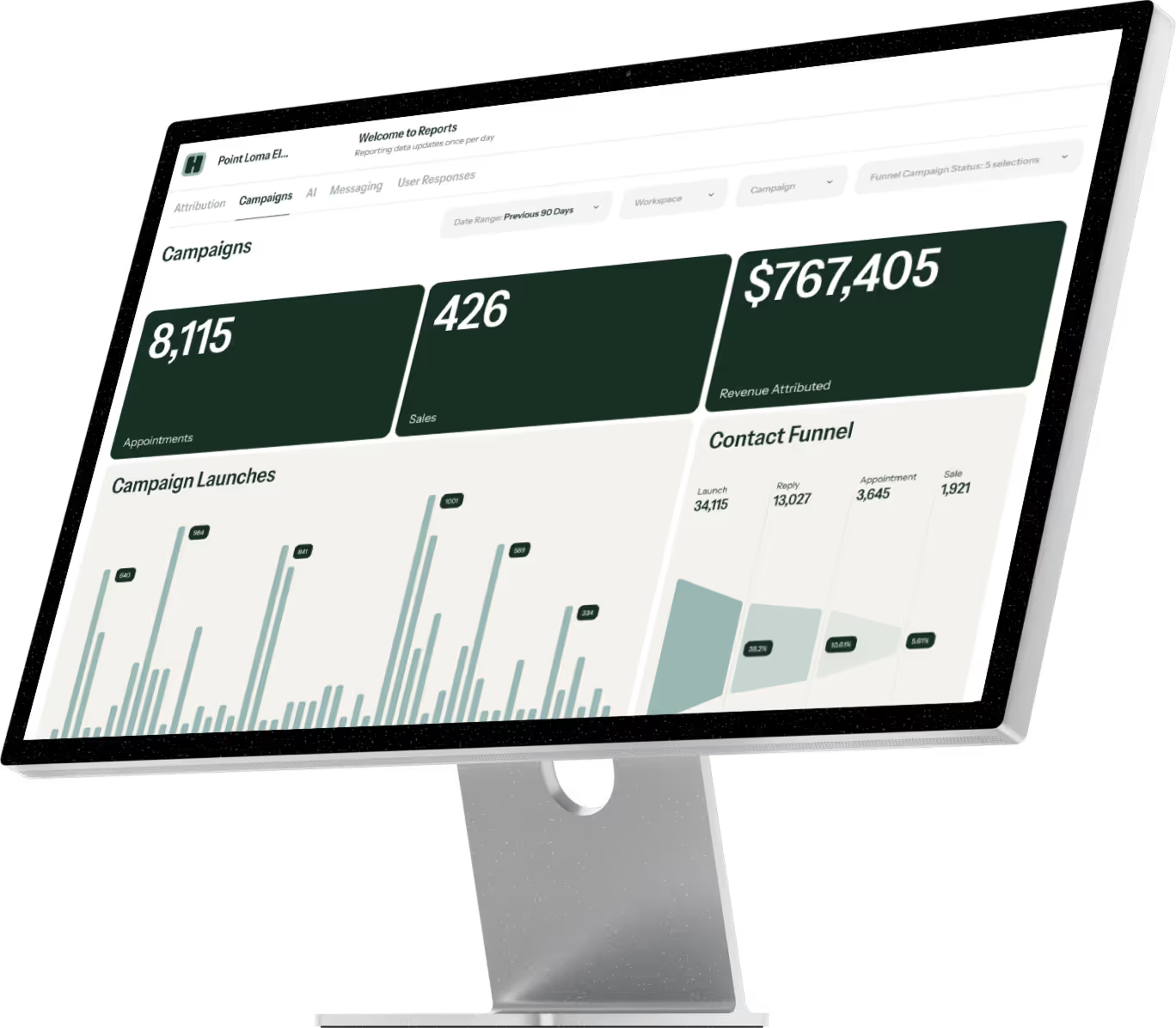
Hatch is built for this full-journey approach. The platform combines Voice AI that answers and qualifies calls 24/7 with text and email automation that keeps conversations moving forward. When a homeowner calls at 2 AM about a broken furnace, Hatch books the appointment directly into your ServiceTitan or Housecall Pro schedule. When a customer receives a $12,000 system replacement estimate, Hatch follows up at the right intervals to answer questions and schedule installation. When your technician completes a job, Hatch can reach out to past customers with similar equipment for seasonal maintenance reminders.
The difference is integration depth. Two-way sync with field service software means Hatch sees your real-time availability, creates job records, and updates when work is completed. This eliminates the double-booking and manual data entry that come with point solutions. For HVAC operations running ServiceTitan, Housecall Pro, or Jobber, this native connection turns AI from a helpful add-on into a core part of how your business responds to demand.
HVAC companies working with Hatch typically start with after-hours call coverage, then expand to peak-season overflow, estimate follow-up sequences, and customer reactivation campaigns as they see results. The goal isn't replacing your team. It's giving them the capacity to focus on complex situations and customer relationships that need human judgment, while AI handles the routine communication that keeps jobs moving and customers engaged.