What's in this post
- Play 1: AI-powered inbound call handling
- Play 2: AI-powered speed-to-lead
- Play 3: AI-powered estimate follow-up
- Play 4: AI-powered year-round capacity engine
- What to measure during busy season
Play 1: AI-powered inbound call handling
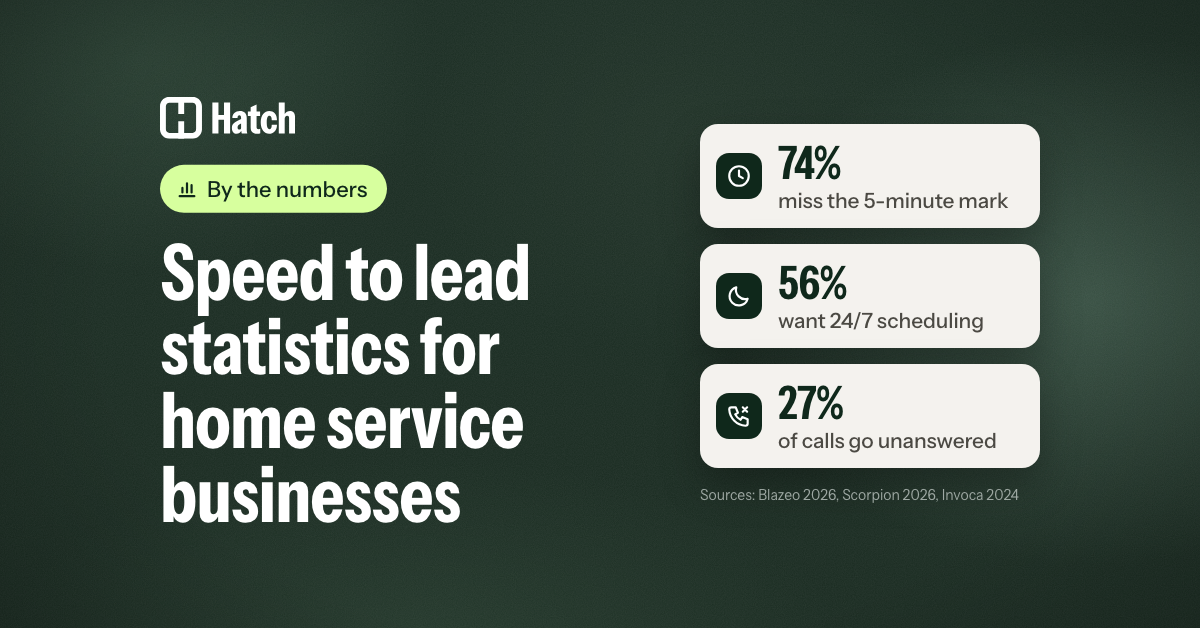
Busy season can more than double your call volume, and up to 50% of those calls may not even be leads. They're status checks, vendor calls, job applications, rescheduling requests, and spam. Even if you wanted to hire your way out, you can't.
The old way: staff up CSRs to match volume, watch your abandoned call rate stay stuck anyway, burn out the team, and pay for ad spend on leads you can't answer.
The new way: put AI on the phones as the front door, and let humans handle the conversations that need them.
"Even though we were adding more CSRs, we only got the abandoned call rate to where we wanted it when we actually brought AI onto the phones." — Rich Jordan, CEO, High Ground Service Pros
Here's what it looks like in practice:
- AI answers every inbound call on the first ring, 24/7
- AI follows your scripts and knowledge base to qualify the call, gather info, and book directly into ServiceTitan when possible
- For complex calls or upset customers, AI escalates with a live warm transfer, and passes a 2–3 sentence summary so the CSR doesn't start from zero
- Spam, vendor calls, and quick hang-ups are filtered automatically, keeping CSR queues clean and reporting accurate
- 75–80% of inbound calls are handled end-to-end by AI; humans focus on escalations and high-value conversations
Your call volume surges, your CSRs aren't drowning. Phones get answered, booking rates go up, abandoned call rate drops, and customer experience improves. AI handles the noise, and your team handles the conversations that move revenue.
High Ground Service Pros brought AI in to handle overflow first, then expanded to the front line — saving on hiring while booking more of every bookable lead. Their abandoned call rate dropped from 10% to 2%, 81% of bookable leads got booked, and they saved $250–300K annually on hiring.
Shafer Services moved off voicemail and onto Voice AI: now booking 80% more appointments from after-hours and overflow calls. Voice AI handles 200–300 calls per month and sets 90+ appointments without a single human touch. As their Director of Marketing Adrianne Gosselin put it:
"No one leaves voicemails anymore, and even if they do, there's no qualifying the call. AI is conversational, empathetic, and qualifies leads, and customers feel confident they're taken care of instead of hanging up and going to a competitor."
Play 2: AI-powered speed-to-lead
3–5 contractors receive the same lead from aggregators, and 78% of consumers go with the first one to reach out. Google LSA and other ranking algorithms reward fast responses. A fast first response is now table stakes — winning the job means staying just as fast through every reply that follows.
One operator we spoke with contacted a homeowner within 38 seconds of receiving a lead. The homeowner told him he was already the third company to call.
"I knew that some of our competitors were starting to use automation because their listings were showing that they were replying within minutes while we were listed as hours." — Tyler Cassavore, Peaden
"We work so hard to work these leads, and all it takes is going on break or clocking out for the day and we lose that lead." — Chelsea Muniz, Point Loma Electric and Plumbing
Here's how top Hatch customers do it:
- Lead sources integrate natively with Hatch, so there's no waiting for leads to hit the CRM and no monitoring six different dashboards
- The moment a lead comes in, an AI agent reaches out across voice, SMS, and/or email — any combination, any cadence
- The AI agent handles the customer's response, qualifying the lead, answering questions, and either booking or escalating
- Each lead source gets its own campaign so performance can be attributed cleanly back to channel
- Win-back and slippage campaigns help recover leads that never booked
Your aggregator leads convert, your LSA ranking climbs because Google sees you responding faster than competitors, and you stop losing leads to the company who answered first. Sub-30-second response times, higher LSA rankings, and higher booking rates from the same lead spend — and CSRs are free to focus on conversations that actually need a human.
Peaden runs inbound voice AI and speed-to-lead across Google LSA, Angi, and other lead sources, hitting an 82% Google LSA response rate, 73% Angi response rate, and nearly tripling conversion on after-hours and overflow calls.
"We treat Hatch as a marketing spend, and it's been our lowest cost of acquisition." — Reyn Rogers, Director of Strategic Growth.
SwiftPro HVAC doubled their Yelp response rate by deploying AI agents for initial outreach — from 29% to 60%.
"I have been amazed to see that the AI agents are more successful than our humans, including me, in getting customers to talk." — Tyler Griffin, Founder/CEO.
Play 3: AI-powered estimate follow-up
80% of estimates don't close in the home, but they're not dead. People are distracted, comparing quotes, or waiting on financing.
Human follow-up is wildly inconsistent. Top reps do 3–4 touches at best, but conversions can take anywhere from 5–12 touches — and once you multiply that by hundreds of estimates a month, the math falls apart.
"Our sales team is not great at consistent follow up. Usually our top performers follow up very well, but even then there's room for improvement." — HVAC operator, from 100 sales calls Hatch analyzed
For multi-location operators, the problem compounds. Each brand has its own rep, its own playbook, its own version of follow-up. There's no source of truth.
Here's how top Hatch customers do it:
- Hatch integrates natively with your CRM so audiences can be built off any CRM criteria — recent estimate, aged estimate, location, service type, rep, and more. When a customer matches the criteria, they automatically enroll in a campaign
- The AI agent runs the campaign, reaching out across voice, SMS, and/or email — any combination, any cadence
- When the customer responds, the AI agent runs the conversation, qualifies, and either books or hands off to a human
Volume of estimates spikes, but follow-up doesn't slip. Every estimate gets followed up on consistently and properly, and your sales team converts more without working more. ISRs and sales reps focus on closing, not chasing.
Reliable Power Systems uses Hatch for unsold estimate follow-up. If 300 customers get an estimate and 100 close in-home, that leaves 200 unsold. Hatch's automated follow-up converts an additional 20–25 sales per month from that group.
"The amount of muscle it takes for a human to follow up with every customer is overwhelming. With Hatch, we've been able to close that gap. I know every customer is getting reached out to, with the messaging I want." — Brian Duncan, Sales Director.
One enterprise Hatch customer — a multi-state HVAC, plumbing, and electrical operator — doubled inside sales revenue to $400K/month per rep by automating follow-up that previously had reps stuck in ServiceTitan dialing 50–75 calls a day.
"Hatch has been a force multiplier for us. So instead of dialing all day and getting five conversations, they're now having 50 conversations a day each."
Play 4: AI-powered year-round capacity engine
Top operators don't try to staff for peak. They build a system that handles volume swings without breaking, while capturing the data they need to fill the schedule when phones slow down.
The old way: hire CSRs to match peak volume, watch them sit idle in March, and hire again next year because the team you built burned out.
The new way: expand capacity per CSR, not headcount. Build the engine once, and let it scale with you.
Every CSR you hire scales linearly with hidden costs: training, management overhead, and performance monitoring. As the team grows, consistency and service quality get harder to hold.
"I can never staff a call center for when it's 95 degrees outside. If I did, I'd have people twiddling their thumbs in March." — Chad Peterman, CEO, Peterman Brothers
"When you're continually onboarding CSRs, and just managing this enormous team, quality across that team diminishes." — Rich Jordan, High Ground Service Pros
Here's what the full engine covers:
- Inbound call handling — AI answers and triages every call, escalating only when needed
- New leads and estimates — Speed-to-lead and estimate follow-up campaigns that book and close
- Customer care — Appointment confirmations, project updates, financing happy calls, and review requests
- Past customers and members — Membership promotion, recurring services, aging equipment campaigns
- Lead nurture and marketing blasts — Re-engage unbooked leads and unclosed estimates
During peak, the same team handles 3x the call volume with flat headcount. Off-season, that same capacity keeps the schedule full. CSRs stop drowning in repetitive volume and move into higher-value roles like coordinator, dispatcher, or sales — and the team's job shifts from "handle every call" to "handle the calls that matter."
High Ground Service Pros stopped ballooning CSR headcount and promoted several to coordinator and dispatcher roles, while running outbound campaigns to their existing database generating $100–250K per month.
"We've been able to invest in the people we have, giving them raises, and increasing responsibility outside of just answering the phone and booking jobs." — Rich Jordan.
Apex Service Partners automated lead qualification and appointment setting, freeing reps to focus on closing instead of qualifying: 8.5x higher set rates (2% → 17%), $50K added monthly revenue per location, 380 hours saved monthly across the team.
"We're now bringing in 20% more revenue per month, even during shoulder season, because we have more time to sell."
What to measure during busy season
If you want to know whether your capacity engine is working, watch these weekly. Most are invisible until they're broken.
- Abandoned call rate — target under 3%
- First-ring answer rate — on inbound
- Speed-to-lead response time — by channel; target under 30 seconds
- After-hours capture rate
- Booking rate by source — LSA, Angi, web form, etc.
- AI containment rate — share AI handles end to end; enough? Too much?
- Bookable booking rate — of calls that could book, how many did? Target 80%+
- Aged estimate disposition rate — are leads getting tagged for win-back?
From staffing for peak to building for the full year
The operators who win busy season aren't the ones who hired the most CSRs. They're the ones who expanded what their existing team could handle, captured the data along the way, and built an engine that keeps running once the heat breaks.
That's the shift: AI handles the volume, your team handles the conversations that matter, and the data you collect during peak fills the schedule when phones slow down.
Busy season isn't something to survive anymore. With AI, it's the season to convert peak demand into revenue efficiently and build a pipeline that carries the rest of the year.
Want the complete playbook? Download the 2026 HVAC Busy Season Playbook — built from 100 real sales call transcripts and 11 named Hatch customer case studies — for all five plays, a bonus lead nurture section, and the full metrics guide. Download it here →