Reaching out to new leads immediately is essential, but not every campaign performs equally. So, what makes a successful one? We analyzed 132K+ HVAC Speed to Lead campaigns launched using Hatch to bring you this answer.
And in case you missed it, we did the same study for HVAC estimate follow-up campaigns too. You can view it here.
Let’s dive in.
The TLDR summary:
- Speed is critical: Responding within 5 minutes boosts conversion rates; Hatch AI CSRs reply in 5 seconds, outperforming most human users.
- Best practices win: Top campaigns send 7 messages (5 texts, 2 emails) over 5 days, with concise, text-first outreach and clear calls-to-action.
- Multi-touch strategy works: It takes 8+ touches to engage decision-makers; campaigns with one message perform poorly (8% response rate).
- Higher response rates = more appointments: Improving response rates from 20% to 80% can quadruple appointments with the same lead volume.
- The template of the top performing campaign is in this Speed to Lead Playbook
What is a speed to lead campaign?
A Speed to Lead campaign is a campaign in Hatch for reaching out to inbound leads. Each lead source has its own campaign, such as for Angi Leads, Google LSA, your website, and more. Each campaign has a series of texts, emails, and sometimes ringless voicemails that send out over the course of several days, until the contact responds.
And once the contact responds, your AI CSR will handle that initial interaction, asking the rinse-and-repeat questions and qualifying the lead so that once it reaches a human, the bulk of the work is done.
This is one of our most popular campaign types in Hatch, since
- 78% of consumers go with the business that reached out to them first
- It takes an average of 8 touches to get a decision maker to respond.
- Consumers expect immediate responses, not just in the initial outreach but in the subsequent conversation.
Doing this type of outreach, follow-up, and rapid response for every new lead that comes in across every lead source is impossible to do manually, so this type of automation is key.
Hear it in 46 seconds from Jon Ryan of Genz-Ryan:
That being said, let's take a look at HVAC response rate benchmarks for Speed to Lead campaigns in Hatch.
Average response rate for HVAC Speed to Lead campaigns in Hatch
The best performing campaign had a response rate of 89.86%. The worst performing campaign had a response rate of 8.56%. The average response rate was 60%.
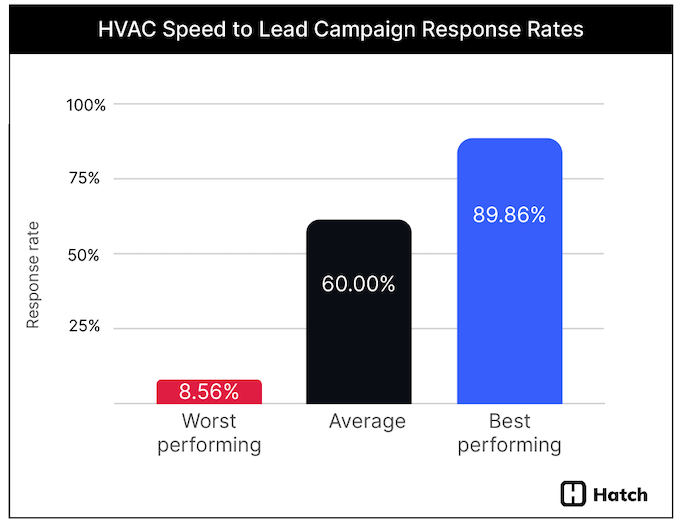
So if you're in the 60% range, that's great, right? Well no, it isn't. It's..average. A smaller portion—but still several thousands of campaigns—had response rates above 80%.
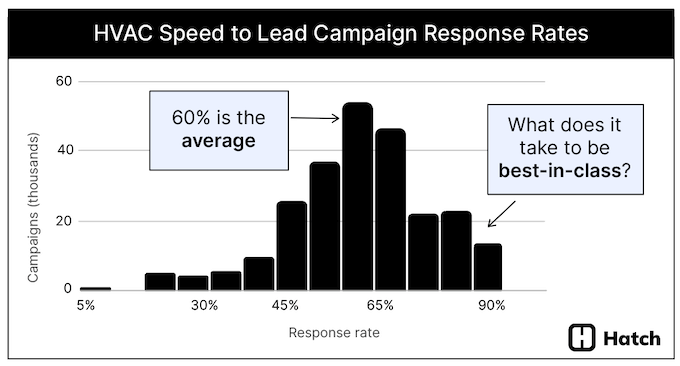
So what does it take to have a best-in-class Speed to Lead campaign? This chart sums up the comparison between the best and worst-performing campaigns:
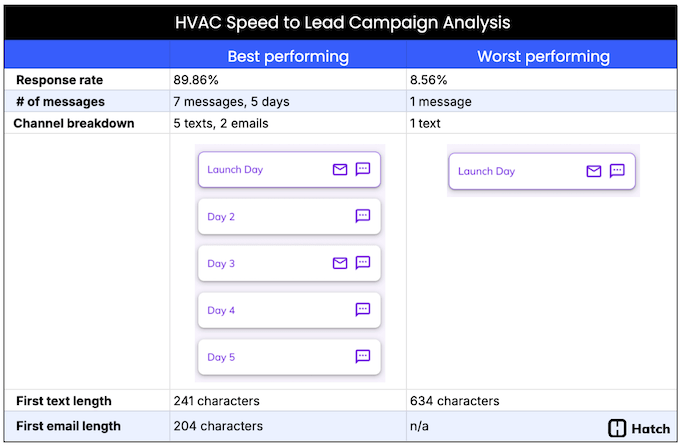
We dive into the details below.
Qualities of the best-in-class HVAC Speed to Lead campaigns
Note that performance in this study is defined by response rate.
The best-performing Speed to Lead campaign in this study (with a 90% response rate) had the following characteristics:
- 7 messages total
- Consisting of 5 texts and 2 emails
- Over 5 consecutive days
- First text: 241 characters
- First email: 204 characters
- Uses our Speed to Lead Template in our Speed to Lead Playbook
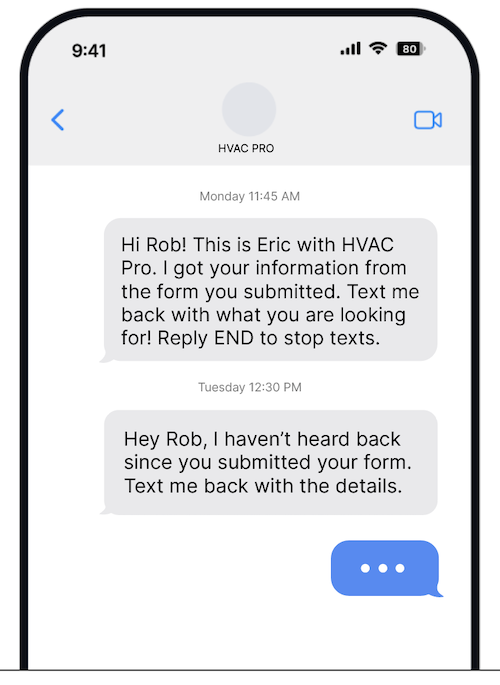
Actual verbiage of the first two text messages of the above-mentioned campaign template. Get the full template in our Speed to Lead Playbook.
The worst-performing campaign (with an 8% response rate) had the following characteristics:
- 1 message
- 634 characters
We won't reveal the verbiage of this message as it's specific to the business and want to preserve its confidentiality.
Takeaway #1
There's a reason why our template is the one used in the top-performing campaign: It uses SMS messaging best practices.You can see all of those best practices in detail in the link provided, but here is the short summary:
- Short messages: 160-250 characters (the higher range is to account for required compliance verbiage).
- Invite a response: End with a clear ask that requires a simple answer. Don't put any work on their plate.
- Use multiple channels: Text and email (voicemail is good too!), but make sure it's text-first.
- Multiple touch: It can take 8-12 touches to get a response, let alone close a deal. This template reaches out over several days.
- Sent immediately: Hatch integrates with your lead sources so that as soon as a lead comes in, they receive the outreach message. Conversion rates drop 8x after the first five minutes.
As you can see, there isn't one silver bullet that makes an effective lead outreach campaign. It's a combination of factors that captures the response.
This is not to say that a Speed to Lead campaign of any other verbiage, cadence, or channel mix won't perform well. There is flexibility here. As long as they follow the SMS messaging best practices.
Average user reply times
Speed to lead campaigns focus on getting a response from a lead who has inquired about your business. And as the name of the campaign implies, speed is the key. But those responses will not translate into appointments or sales if you cannot maintain that speed once the lead responds to you.
"Average user reply time" is a metric in Hatch that measures the time it takes for a rep to reply to a contact once that contact has responded to an automated campaign message.
And it is equally as important as the time it takes to make that first outreach.
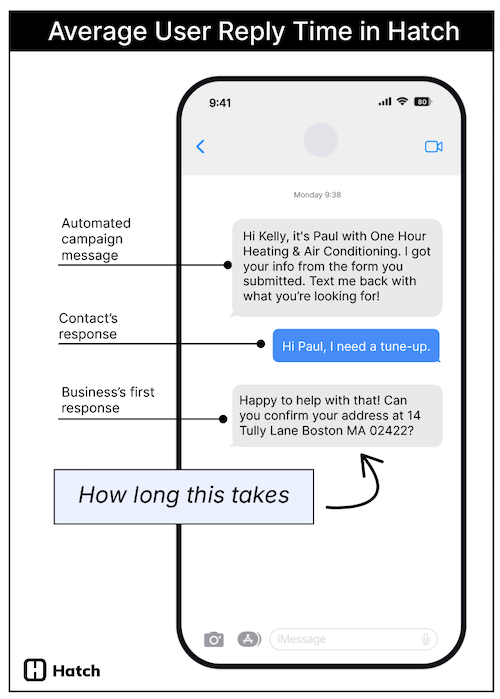
Average first response times in this study are as follows:
- 88% of users (941 of 1,071) are taking more than 5 minutes to reply to leads.
- The most common response times were 1 day (37% of users), followed by 30 minutes (33% of users)
- Only 3% of users are responding in less than a minute.
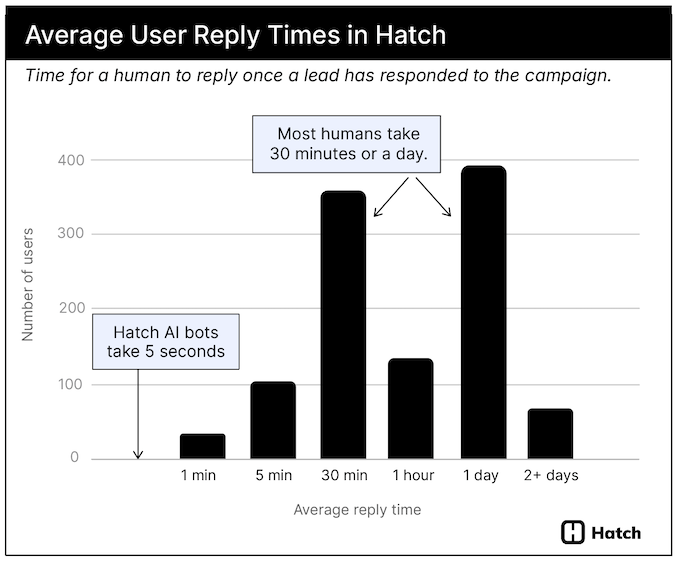
Compare this to Hatch AI CSRs that respond in 5 seconds no matter what. They also work after hours and don't take breaks or vacations. This type of speed to conversation reply is crucial for keeping the lead engaged and securing them for an appointment.
Takeaway #2
So the takeaway here is, if you haven't explored Hatch AI CSRs, here are some ways to do so:
- Try it yourself <-- Click there to interact with a Hatch AI CSR as if you were a homeowner seeking HVAC services through Google LSA.
- Book a demo
- Watch a demo
- Read our Hatch AI success story for Apple Aire
Here's a 30-second clip from the above case study:
What does an 80% response rate look like?
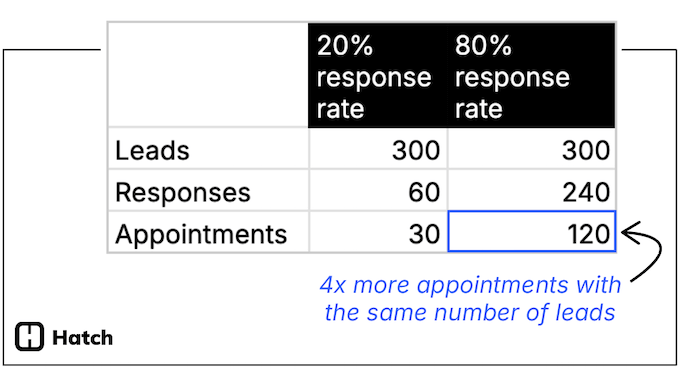
So what's the big deal about increasing response rates? Well, let's say you follow our best practices above and you improve your response rate from 20% to 80%.
Let's then also say that you've generated 300 leads and that you average a 50% set rate on the leads that respond to you.
At a 20% response rate, you'd get 30 appointments out of 300 leads. At an 80% response rate, you'd get 120 appointments out of 300 leads. That's 4x more appointments for the same lead volume.
Wrap-up
If you can get 60% of your leads to respond to you, that's good. But if you can get 80% or even 90%, that's great. That's best in class. And it's doable. The key is in the verbiage and the velocity. Use the takeaways and templates we've provided here and in our Speed to Lead Playbook so you can start getting a higher ROI on your lead spend.
Speed is everything. Hear it from one of our customers in 19 seconds:
FAQs
What lead sources were used in this study?
The lead sources for these campaigns included Angi Ads, Angi Leads, Blue Corona, Costco, Facebook, Google Ads, HomeYou, Home Depot, Lowes, Modernize, PPC Scorpion, Thumbtack, Website leads, Yelp, WinGen, and more.
How was this data collected?
These performance metrics were collected by analyzing 132,188 Speed to Lead campaigns launched for HVAC businesses using Hatch over the last 6 months. Campaigns had to have a minimum of 100 campaign launches and a minimum of 100 campaign responses.
What is an HVAC speed to lead campaign in Hatch?
An HVAC speed to lead campaign in Hatch is one where new leads get instantly outreached by companies via direct lead source integration. Automating these campaigns enables businesses to adhere to best practices for getting a response, which includes reaching out immediately, across multiple channels, and following up until they get a response.
Once your customer responds, you can jump in to engage, or you can train an AI bot to do it for you.
I use that same template and I'm not getting a high response rate. What can I do?
The factors above—number of messages, channels used, message verbiage and length, and campaign length—are not the only ones that impact response rates. Other factors include:
- The source and quality of the lead
- Your business's reputation and level of brand awareness
- The location and season
- How much competition you have
- The type of service you offer
If you're a Hatch customer and want to improve your response rates, reach out to your Account manager here and we'll help you. If you're not a Hatch customer and are interested in learning about improving your response rates, you can book a demo here.
Do you have templates for other industries?
None of our templates are industry-specific. Our customers use them across HVAC, remodeling, windows and doors, roofing, electrical, and more. We also have several customers in other verticals such as healthcare and finance. We help you adapt the templates to your business model, and/or to come up with custom templates that work for you, based on best practices.
Have more questions?
Hatch customers, reach out to your Account manager here.
Non-Hatch customers, book a demo here!