
After-hours calls represent a challenge that most HVAC and plumbing companies have not solved. Demand arrives when the office is closed, but answering that demand consistently requires either staff working nights and weekends or an automated system that can handle calls without human involvement.
The statistics in this report show exactly where that demand comes from, what happens when calls go unanswered, and what the revenue consequences look like for service businesses that cannot respond outside business hours.
For companies evaluating their options for after-hours call handling, these numbers establish the baseline: how much volume is at stake, how customers behave when they cannot reach someone, and what booking and revenue patterns look like for businesses that do answer versus those that do not.
Key takeaways
- After-hours HVAC demand changes with the season. Residential HVAC calls outside business hours account for 14.1% of calls in June, compared with 9.8% in October.
- Customers expect businesses to remain responsive. 89% of consumers expect businesses to respond to online reviews, while 42% are unlikely to use businesses that ignore customer feedback.
- Positive reviews can generate new service inquiries. 20% of consumers contact a business after reading positive reviews, highlighting the importance of responding to inquiries and making appointment scheduling accessible.
- HVAC and plumbing companies need to plan for staffing demands. The Bureau of Labor Statistics projects approximately 40,600 annual HVAC job openings and 42,000 plumbing-related openings through 2035.
- Urgent plumbing problems make timely communication important. A malfunctioning toilet valve can waste 4,300 gallons of water per day, reinforcing the need for accessible service requests and after-hours response.
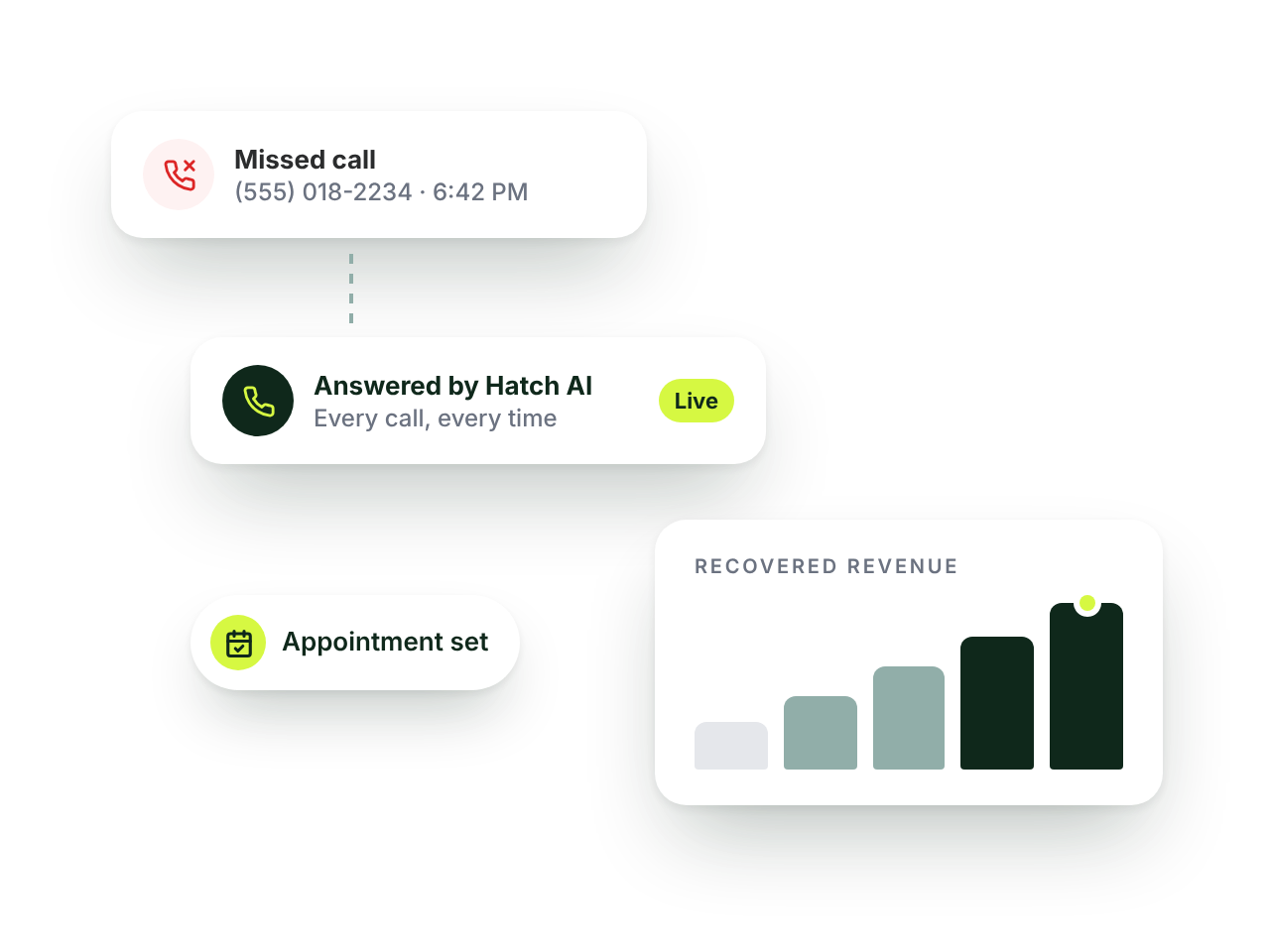
- Automated call handling can extend coverage beyond office hours. For HVAC and plumbing businesses without dedicated evening or weekend staff, solutions such as Hatch Voice AI can help answer inquiries, qualify callers, and support appointment scheduling when employees are unavailable.
Customer behavior and follow-up
1. 89% of consumers expect businesses to respond to online reviews
According to BrightLocal's 2026 Local Consumer Review Survey, 89% of U.S. consumers expect business owners to respond to reviews. For HVAC and plumbing companies, this highlights how responsiveness affects customer perceptions even before someone makes a service call. Answering inquiries is important, but acknowledging feedback also helps demonstrate that the business remains accessible after the job.
2. 42% of consumers are unlikely to use businesses that ignore reviews
BrightLocal's 2026 consumer research found that 42% of consumers are unlikely to use a business that ignores its reviews. For HVAC and plumbing companies, unanswered customer feedback can affect future booking decisions. Maintaining communication after service gives prospective customers another way to assess whether a contractor takes customer concerns seriously.
3. 66% of consumers continue researching after reading positive reviews
Positive reviews do not always lead directly to a booking. BrightLocal found that 66% of consumers continue researching after reading favorable feedback, while 34% are ready to purchase or book. HVAC and plumbing companies need to make their contact information, service availability, and next steps clear so customers can move from researching a provider to requesting an appointment.
4. 20% of consumers contact a business after reading positive reviews
BrightLocal's 2026 survey found that 20% of consumers contact a business after reading positive reviews. Another 20% make an appointment, with respondents able to select multiple actions. This shows how online reputation can generate direct customer inquiries. For HVAC and plumbing companies, these inquiries still need timely responses to turn initial interest into scheduled work.
5. 83% of consumers asked to leave a review went on to write one
According to BrightLocal's 2026 research, 83% of consumers who were asked to leave a review reported doing so. For HVAC and plumbing companies, post-service follow-up can extend beyond invoices and maintenance reminders. Asking for feedback after a completed job gives satisfied customers an opportunity to share their experience and helps future customers evaluate the business.
Industry demand and after-hours coverage
6. HVAC technician employment is projected to grow 11% through 2035
The U.S. Bureau of Labor Statistics projects HVAC technician employment to grow 11% from 2025 to 2035, compared with 3% across all occupations. The agency also notes that HVAC technicians may work evenings, weekends, and irregular shifts during peak seasons. For HVAC companies, this reinforces the importance of planning service and customer communication coverage beyond standard office hours.
7. Approximately 40,600 HVAC job openings are projected annually
The Bureau of Labor Statistics estimates approximately 40,600 HVAC technician openings annually between 2025 and 2035. Many openings will result from workers leaving the occupation or retiring. For HVAC businesses managing staffing constraints, maintaining consistent call coverage and appointment scheduling is an operational consideration, particularly during seasonal demand spikes.
8. Approximately 42,000 plumbing job openings are projected annually
According to the Bureau of Labor Statistics, approximately 42,000 openings for plumbers, pipefitters, and steamfitters are projected each year from 2025 to 2035. The agency also notes that plumbers frequently work nights and weekends and remain on call for emergencies. Plumbing businesses need to coordinate emergency service availability with the ability to receive and respond to customer inquiries outside regular business hours.
Plumbing service urgency
9. Household leaks can waste more than 9,300 gallons of water annually
The U.S. Environmental Protection Agency reports that household leaks can waste more than 9,300 gallons of water annually. Some leaks involve running toilets, dripping faucets, and other faulty plumbing fixtures. While this does not measure after-hours call volume, it illustrates why plumbing problems require timely attention and why homeowners may need a way to request service outside regular office hours.
10. A malfunctioning toilet valve can waste 4,300 gallons of water per day
The EPA's 2026 guide to leak detection reports that a stuck toilet fill valve can waste 4,300 gallons of water daily and potentially add up to $1,400 in monthly water costs. For plumbing companies, situations involving substantial water loss demonstrate why some inquiries are urgent and why communicating promptly about service availability matters.
{{in-line-cta}}
After-hours call volume statistics
11. 14.1% of residential HVAC calls arrive outside business hours at June peak
Summer drives HVAC demand, and the after-hours share rises with it. At the June peak, 14.1% of residential calls come in outside standard business hours, according to ServiceTitan's State of the Trades data.
That share is nearly 45% higher than the October low of 9.8%. Businesses planning their after-hours coverage need to account for this seasonal swing, particularly when cooling demand peaks and homeowners call about AC failures in the evening.
12. 9.8% of residential HVAC calls arrive outside business hours in October
The shoulder season brings lower overall volume and a smaller after-hours share. In October, only 9.8% of residential calls arrive outside business hours.
This seasonal drop gives HVAC companies more coverage during normal hours but does not eliminate the need for after-hours response. One in ten calls still arrives when the office is closed.
13. After-hours calls cluster between 5 PM and 9 PM
The highest concentration of after-hours calls for home services companies falls in the early evening window, according to ServiceTitan data.
For service businesses, this matters because the 5 PM to 9 PM window is the most likely time for staff to have gone home for the day. Late-night and early-morning calls exist but represent a smaller share of total after-hours volume.
14. 4.9% of residential HVAC calls arrive on weekends in August
Weekend volume peaks during the hottest month. In August, 4.9% of residential calls come in on Saturday or Sunday.
Weekend calls are a smaller absolute share than weekday evening calls, but they still represent demand that requires either weekend staffing or an automated response.
Customer behavior when calls go unanswered
15. 78% of consumers have abandoned a business after an unanswered call
In a CallRail survey of 1,000 U.S. consumers, 78% said they had stopped doing business with a company after their call went unanswered.
This does not mean every unanswered call results in abandonment. But it does show that most consumers have reached that point at least once. The survey measures self-reported behavior, not observed behavior, but the pattern is clear: unanswered calls cost customers.
16. 82% of consumers say they would call a competitor if a business doesn't answer
The same CallRail survey found that 82% of consumers would call a competitor rather than wait for a callback.
For service businesses, this means the window to respond is measured by how quickly a competitor can answer. In markets with multiple providers, the first company to respond often gets the job.
17. 21% of consumers immediately call another business without waiting
One in five consumers calls another business right away when their first call is not answered.
This group does not leave a voicemail, does not wait for a callback, and does not try again later. They move on immediately. For after-hours calls, where staff are unavailable to return the call quickly, this 21% is likely higher.
18. 41% of consumers hang up after 1-2 minutes on hold
Consumers do not wait long. 41% hang up after just one to two minutes on hold.
For businesses using automated phone systems or hold queues as part of their call flow, this means lengthy hold times cost calls. The tolerance for waiting is low, particularly for callers who need service and have alternatives.
Booking rates and conversion
19. 38% average booking rate for HVAC calls
Across HVAC companies tracked by ServiceTitan, the average booking rate is 38%.
This means 62% of calls that reach a person do not result in a booked appointment. Some callers are not ready to book, some have questions that do not lead to service, and some are lost to competitors or poor call handling.
20. 43% average booking rate for plumbing calls
Plumbers convert calls to jobs at a higher rate. The 43% average booking rate is the highest among trades tracked by ServiceTitan.
The higher rate likely reflects the emergency nature of many plumbing calls. When a pipe is leaking, the customer is ready to book.
21. 59% booking rate for businesses with 25+ technicians
Larger shops book at significantly higher rates. Businesses with 25 or more technicians achieve a 59% booking rate.
This may reflect better-trained staff answering calls, dedicated call center employees, or simply more capacity to take on work. Whatever the cause, the correlation between business size and booking rate is clear.
22. 24% booking rate for businesses with fewer than 5 technicians
Small shops struggle to convert calls. Businesses with fewer than 5 technicians book only 24% of calls.
The 35-percentage-point gap between small and large shops represents a significant competitive disadvantage. Small businesses often lack dedicated phone staff, meaning technicians or owners answer calls between jobs, which affects both availability and call quality.
What these statistics mean for service businesses
The data points to a consistent pattern: demand exists outside business hours, but most service businesses are not set up to capture it.
Plumbing sees 42% of calls outside standard hours. HVAC ranges from 10% to 14% depending on the season. But HVAC answers only 34% of calls with a person, and more than three-quarters of consumers have abandoned a business after an unanswered call.
The gap between demand and coverage creates an opportunity for businesses that can respond consistently. The 73% of emergency callers who hire the first company that answers, the 400% conversion boost from responding within 5 minutes, and the 28% ticket premium on after-hours jobs all point to the same conclusion: responsiveness pays.
For businesses that cannot staff nights and weekends, the question becomes how to add coverage without expanding headcount. Voice AI can answer and qualify calls around the clock, handling the inquiry and booking stages while the team is unavailable. The broader Hatch platform extends that coverage through follow-up, confirmation, and ongoing customer communication.
The statistics do not guarantee any particular result for any particular business. But they do establish the baseline: after-hours demand is real, most businesses are not capturing it, and the customers who call outside business hours are ready to book if someone answers.